Boost Growth with automated phone answering service for SMBs
Discover how automated phone answering service helps SMBs capture every lead, cut costs, and elevate support. Learn more in our expert guide.Let's be honest, you can't be available to answer the phone 24/7. But your customers expect you to be. An automated phone answering service is the solution to this classic business problem—it's like having a digital receptionist who never sleeps, gets sick, or takes a vacation.
This isn't just a fancy voicemail. It's an intelligent system that uses AI to talk to your callers, understand what they need, and take real action, like booking an appointment or routing the call to the right person. The goal is simple: make sure you never miss an opportunity just because you couldn't get to the phone.
What Is an Automated Phone Answering Service?

Think of this service as your most reliable team member. When a customer calls, they aren't just dumped into a voicemail abyss. Instead, they're greeted by a helpful, conversational AI that can actually get things done.
This technology is designed to figure out why someone is calling. Are they a new lead wanting to schedule a consultation? An existing client with a question about your hours? Whatever the reason, the system can provide instant answers, take down information, or seamlessly transfer the call to the right department.
This solves one of the biggest headaches for small businesses: missed calls. Every unanswered ring is a potential lost customer. This system turns that around by providing an immediate, professional, and genuinely helpful response every single time.
More Than Just a Voicemail
Your standard answering machine just sits there and records a message. It puts the burden back on you to listen, prioritize, and call back later. An automated phone answering service, on the other hand, is an active part of your team.
It’s a frontline agent that can:
- Qualify Leads: The system can ask a few smart questions to figure out if the caller is a hot lead ready to buy.
- Schedule Appointments: By connecting directly to your calendar, it can book meetings and service calls in real-time, without you lifting a finger.
- Provide Instant Answers: For all those common questions—"Where are you located?" or "Are you open on Saturdays?"—it delivers information immediately, freeing up your staff for more complex work.
- Route Calls Intelligently: It’s like a smart switchboard, figuring out who the caller needs to talk to and connecting them without frustrating transfers.
The core value here is turning every phone call from a potential interruption into a productive outcome. It guarantees that every caller gets the help they need, right when they need it.
This move from passive message-taking to active call management is what makes these modern solutions so powerful. Let's break down how it stacks up against the old ways of doing things.
Automated Answering vs Traditional Methods
To see the difference clearly, here’s a quick comparison of how automated services measure up against a human receptionist and a basic voicemail system.
| Feature | Automated Answering Service | Human Receptionist | Basic Voicemail |
|---|---|---|---|
| Availability | 24/7/365, including holidays | Limited to business hours | Always on, but passive |
| Cost | Low, predictable monthly fee | High salary and benefits | Typically included with phone plan |
| Call Handling | Manages multiple calls at once | Handles one call at a time | One call at a time |
| Lead Capture | Instantly qualifies and schedules | Can be effective but inconsistent | Delays lead follow-up |
| Efficiency | Fully automated and consistent | Prone to human error or distraction | Requires manual follow-up for all calls |
As you can see, the automated approach offers a compelling mix of round-the-clock availability, cost-effectiveness, and efficiency that traditional methods just can't match.
How AI Voice Agents Power Modern Answering Services
The real secret behind a modern automated phone answering service isn't just a simple recording. It’s a smart AI voice agent that can actually listen, understand what the caller wants, and then do something about it. We've come a long way from the clunky, robotic "press one for sales" systems of the past.
Think of it like this: a basic translator can swap words, but a great one understands context, nuance, and what someone is really trying to say. That’s what today’s AI voice agents do for your business. They figure out the caller's intent, not just the literal words they use.
This is what allows the system to handle complex requests with surprising accuracy. Whether someone says, "I need to book an appointment," or mumbles, "Got anything open next Tuesday afternoon?" the AI gets the point and takes the right action. The result is a smooth experience that makes your callers feel heard and confident.
The Three Steps of an AI Conversation
Every call an AI agent handles successfully follows a straightforward, three-step process. This is what separates an intelligent system from a basic answering machine—it’s the engine that powers every helpful response and every booked meeting.
Here’s a look under the hood:
-
Recognize Spoken Words: First, the AI has to hear what’s being said. It uses Automatic Speech Recognition (ASR) to turn the sound of the caller's voice into text, almost like a court stenographer typing in real-time.
-
Understand True Intent: This is where the magic happens. Using Natural Language Processing (NLP), the AI analyzes that text to figure out what the caller actually wants. It looks past the specific phrasing to identify the goal, whether that’s scheduling, asking for info, or getting help.
-
Decide and Act: Once it knows the goal, the AI decides what to do next. It taps into its programmed instructions and connects to your other tools (like your calendar or CRM) to take action. This could mean offering up available appointment times, answering a common question from its knowledge base, or transferring the call to a human specialist when needed.
This simple, structured approach ensures every call is handled logically and efficiently, always with the caller's goal in mind.
Why This Technology Is So Effective Now
This technology isn't new, but it's suddenly become incredibly powerful and accessible. The widespread adoption of voice assistants in our homes and on our phones has completely changed what people expect from a phone call, and businesses are now reaping the rewards of those same advancements.
Consider this: there are now over 8.4 billion voice assistants being used around the world, a number that has doubled in just four years. This is part of a much bigger trend, with the conversational AI market expected to reach $49.8 billion by 2031. The impact on businesses is real and measurable. Contact centers using AI voice agents have seen a 14% increase in issues resolved per hour and a 9% drop in the average time it takes to handle a call. You can dig into more call center statistics that highlight these trends to see just how much AI is changing the game.
This isn't just about picking up the phone; it's about getting things done. The AI acts as a reliable first point of contact, taking care of all the routine stuff so your team can focus on the complex conversations that truly need a human touch.
This ability to handle common requests without pulling your team away from their work is what makes an automated phone answering service so valuable. It gives you efficiency, consistency, and 24/7 availability, all while providing a professional and genuinely helpful experience for every single person who calls.
What This Actually Means for Your Business
Knowing how the technology works is interesting, but what really matters is how an automated phone answering service can make a real difference to your business. We're not just talking about picking up the phone; we're talking about turning every single call into a concrete result—more appointments, happier clients, and a team that isn't constantly tied to the phone.
Let's look at the core features and see how they translate into tangible benefits you can actually measure.
At its heart, the AI follows a simple but powerful three-step process for every call. It listens, figures out what the person wants, and then takes the right action.
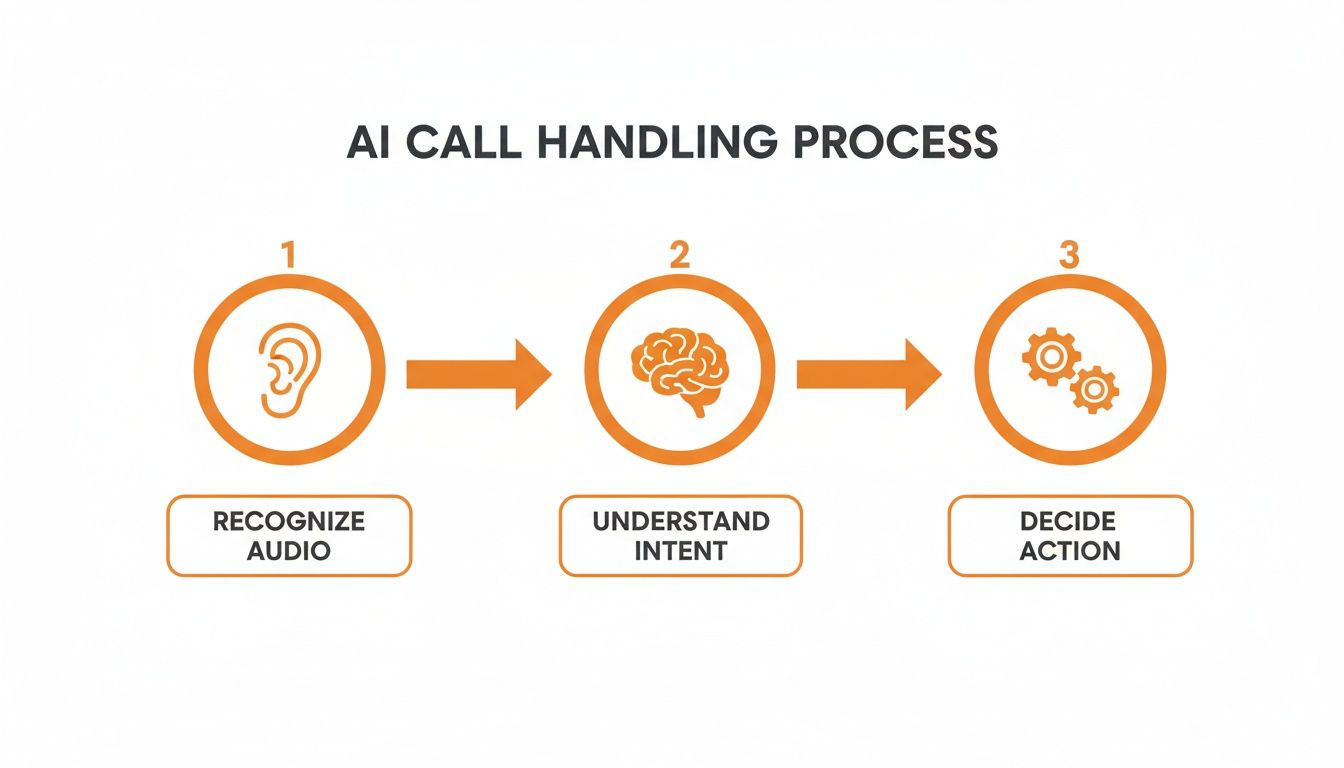
The magic is in that middle step—understanding the goal. This allows the system to do something useful, like book an appointment, instead of just taking a message.
Capture Every Single Opportunity with 24/7 Availability
You might lock up at 5 PM, but your potential customers don't stop searching. A missed call is a missed opportunity, simple as that. When your phone rings and no one answers, that person is just a quick Google search away from calling your competitor.
- The Feature: 24/7 Call Capture. The AI is always on duty. It's there to provide a professional greeting during a hectic lunch rush, in the middle of the night, or on a holiday weekend.
- The Business Benefit: More Leads in the Pipeline. By answering every call, you instantly capture leads that would have been lost forever. A potential client calling at 9 PM on a Tuesday can get their consultation booked for the next morning instead of just giving up.
This turns your phone line from a business-hours-only tool into a reliable, around-the-clock machine for bringing in new business.
Stop Frustrating Callers with Intelligent Routing
Let's be honest: nothing makes a caller hang up faster than being bounced between departments or getting stuck in a confusing phone menu. Smart routing gets people where they need to go on the first try.
- The Feature: Smart Call Routing. The AI quickly understands why someone is calling and sends them to the right place. A hot sales lead can be sent straight to your top agent's calendar, while a simple billing question gets routed to the right person in the office.
- The Business Benefit: Happier Customers (and More of Them). A smooth, efficient first contact shows you respect the caller's time. That builds trust and goodwill right from the start.
When you get rid of those awkward transfers and long hold times, you create a professional first impression that sets the tone for the entire relationship.
The numbers back this up. These statistics aren't just hypotheticals; they represent real-world gains businesses are seeing right now.
Quantifying the Impact of Key Automation Features
| Metric | Reported Improvement with Automation | Primary Business Benefit |
|---|---|---|
| Routine Inquiry Handling | 70% of inquiries handled without human help | Frees up staff for complex, high-value work. |
| Cost Per Call | Average savings of $5.50 | Directly lowers operational costs and boosts margins. |
| Agent Labor Costs | $80 billion in projected global savings by 2026 | Reduces payroll expenses and improves team efficiency. |
| Average Handle Time | 40% reduction | Faster service leads to higher customer satisfaction. |
These figures highlight a clear trend: automation isn't just about convenience—it's about driving significant financial and operational improvements. For a deeper dive into these numbers, you can explore the research behind AI-driven cost savings and see how these tools deliver a strong return on investment.
Take Scheduling Off Your Team's Plate
The endless email chain to find a meeting time is a productivity killer. An automated phone service can handle the entire scheduling dance in a single, quick phone call by plugging directly into your calendars.
- The Feature: Real-Time Appointment Booking. The AI sees your team's live availability and offers open slots to the caller right then and there. It can book the appointment, send a confirmation, and even fire off reminders automatically.
- The Business Benefit: A More Productive Team. This frees your staff from mind-numbing admin work so they can focus on what they do best. Your team can walk in each morning to find their calendars already populated with qualified, pre-vetted appointments.
This doesn't just save a ton of time; it also cuts down on the human errors like double-bookings that can throw a wrench in your day. It simply helps your entire operation run a lot smoother.
Real-World Use Cases for Small Businesses

It’s one thing to talk about features and technology, but it’s another thing to see how an automated phone answering service actually solves real problems for real businesses. This isn't some generic, one-size-fits-all tool; it’s a focused solution that bends to the unique pressures of different industries.
So, let's step away from the abstract and get on the ground. We'll walk through a few scenarios to show you exactly how this service makes a difference day-to-day.
These examples highlight how a smart answering service goes from being a simple utility to a genuine business asset—one that captures lost revenue, keeps clients happy, and gives you back your most valuable resource: your time.
The Busy Real Estate Agent
Real estate doesn't punch a clock at 5 PM. A potential buyer could drive by a house at 9 PM on a Saturday and want answers right then. For a solo agent or a small firm, being on call 24/7 just isn’t sustainable.
-
The Problem: An agent is in the middle of a showing and misses a call about a hot new listing. The caller is eager and ready, so when they don't get an answer, they move on to the next agent on their list. Just like that, a lead—and a potential commission—vanishes.
-
The Solution: The agent brings in an automated answering service. Now, when that late-night call comes through, the AI agent picks up instantly. It provides key property details like square footage and price, then offers to book a viewing on the spot by syncing with the agent’s live calendar.
-
The Result: Instead of a lost opportunity, the agent wakes up to a confirmed appointment already on the books. The system captured a highly motivated lead after hours, making sure the agent was the first to connect with a serious buyer. All of this happened without the agent lifting a finger.
The Overwhelmed Law Firm
For law firms, the initial client intake is everything. It’s also incredibly time-consuming. Paralegals and office staff can spend a huge chunk of their day on the phone asking the same screening questions over and over, just to see if a caller is a good fit.
The real challenge is sifting through the noise. You have to find the qualified clients who match your practice areas without burning through billable hours on calls that go nowhere.
This administrative clog slows down the firm's growth and pulls talented people away from critical legal work.
-
The Problem: A small personal injury firm gets swamped with calls every day. The team is tied up gathering basic info, which means calls get missed during busy periods, and there's less time for actual case management.
-
The Solution: The firm implements an automated system with a custom intake workflow. The AI agent asks crucial pre-qualifying questions, like the type of injury and the date of the incident. It uses the answers to figure out if the caller's case aligns with the firm's focus.
-
The Result: Qualified leads get their consultation scheduled automatically, and their details are piped straight into the firm's CRM. Callers who aren't a fit are politely guided to other resources. The firm reclaims an estimated 5-10 hours of staff time every week and ensures every promising lead gets a professional, immediate response.
The Local Medical Clinic
Medical clinics are in a constant whirlwind of calls for appointments, prescription refills, and simple questions. This non-stop administrative work often prevents the front-desk staff from focusing on the patients standing right in front of them.
-
The Problem: A patient calls to confirm their appointment time, but the receptionist is busy checking in another patient and the phone rings out. The caller gets frustrated, and the clinic risks a costly no-show.
-
The Solution: The clinic deploys an automated answering service to handle all the routine calls. The AI can confirm, reschedule, or cancel appointments, answer FAQs about office hours, and even push out automated appointment reminders. You can learn more about how automated agents are transforming clinics by handling these exact tasks.
-
The Result: Phone calls to the front desk drop by over 40%. This frees up the staff to deliver better, more attentive in-person care. Patients love getting instant answers anytime they call, no-show rates go down, and the whole clinic runs more smoothly without needing to hire more people.
How to Choose the Right Service and Integrate It
<iframe width="100%" style="aspect-ratio: 16 / 9;" src="https://www.youtube.com/embed/tPzrQO5fJmY" frameborder="0" allow="autoplay; encrypted-media" allowfullscreen></iframe>Picking an automated phone answering service isn’t like buying a piece of software. It’s more like hiring a new team member. The right one will feel like a natural extension of your business, catching leads and making callers feel heard. The wrong one? It just creates headaches and leaves customers frustrated.
To get it right, you need a clear plan. It's easy to get distracted by a long list of flashy features, but what really matters is how the service fits into your actual day-to-day work. You have to look at how it connects with the tools you already use, make sense of its pricing, and be sure it meets the security standards for your industry.
The goal is to find a system that doesn’t just answer calls, but truly works with your business, making everything smoother from the get-go.
Your Provider Evaluation Checklist
Before you sign on the dotted line, run through this checklist. Think of it as your interview process for a digital receptionist. A little due diligence now can save you a world of pain later on.
- Integration Capabilities: Does it play well with the tools you already depend on? We're talking about your CRM (like Salesforce or HubSpot) and your calendar (like Google Calendar or Calendly).
- Customization and Flexibility: Can you build call scripts and workflows that actually match how you do business? A law firm, for instance, has a completely different client intake process than a real estate agency. You can explore specific workflows for a law firm phone answering service to see just how specific this can get.
- Voice Quality and Naturalness: Let’s be honest—does the AI sound like a real person, or does it sound like a robot from a 90s movie? A natural, conversational voice builds trust and keeps people on the line.
- Security and Compliance: Does the provider meet the strict rules of your industry? If you’re in healthcare, HIPAA compliance is an absolute must. Law and finance have their own critical data protection standards to worry about.
The Non-Negotiable Need for Seamless Integration
Picture this: your new AI service books a meeting, but it never shows up on your calendar. Or it captures a new lead's info, but that contact never lands in your CRM. That’s what life is like without proper integration, and it completely defeats the point of having an automated system.
Real efficiency happens when all your tools talk to each other. When everything is connected, your service can:
- Instantly Create CRM Records: A new caller’s details are automatically logged in your sales pipeline. No more manual data entry.
- Book Directly into Calendars: Appointments pop up in real-time, which means you can say goodbye to double-bookings.
- Trigger Automated Follow-ups: Once a meeting is booked, the system can automatically send a confirmation email or text.
Integration isn't a "nice-to-have." It's the central gear that makes the whole machine run. Without it, you're just creating more work for yourself.
Decoding Pricing Models
The cost of these services can be all over the map, so it’s important to find a plan that makes sense for your call volume and budget. You’ll typically see a few common pricing structures.
- Per-User/Per-Month: A flat monthly fee for each person on your team who uses the service. Simple and predictable.
- Usage-Based (Per-Minute/Per-Call): You pay for what you use. This is a great option if your call volume goes up and down.
- Tiered Plans: These are pre-packaged bundles of features and minutes at different price points, so you can start small and scale up as your business grows.
The demand for these services is exploding, which tells you something about how businesses are changing the way they communicate. The entire call center industry is on track to hit $500.1 billion by 2030. Right now, 49% of businesses are already using call center software, and another 24% plan to jump in soon. This massive growth shows just how important it is to pick a modern, scalable solution that won't be obsolete in a year or two.
So, where does this leave us?
We’ve walked through what an automated phone answering service is, looked under the hood at the AI that makes it tick, and seen the real-world results it can produce. From real estate offices to busy clinics, the applications are clear.
The big takeaway here is that automation isn't about replacing the human touch—it’s about enhancing it. By letting smart technology handle the routine inbound calls, you give your team back their most precious asset: time. That's time they can use to build real relationships with customers, tackle the tough problems, and actually grow the business.
It's More Than a Tool; It's a Strategy
Bringing in an automated answering service isn't just about adding another piece of software. It's a strategic move that sets your business up for the future. You’re building a more efficient, customer-friendly operation that can grow without piling on costs. Every call the system handles is another minute your team gets back for high-impact work.
Think about the difference this makes right away:
- A More Efficient Team: Tasks like booking appointments and answering common questions get done instantly, freeing your staff from repetitive work.
- Happier Callers: People get quick, useful answers 24/7, which makes for a great first impression and a feeling of reliability.
- Smarter Growth: You can manage more calls and grab more leads without burning out your team.
At the end of the day, this is all about working smarter. It gives your business the power to deliver amazing service around the clock, so you never miss a chance to connect with a customer.
It's like having the perfect assistant—one who never sleeps, manages your front-line communications flawlessly, and frees you up to focus on what truly matters: serving your clients and building your business.
Frequently Asked Questions
Thinking about an automated answering service? It’s natural to have questions. Is this thing going to be a headache to set up? Will it sound like a robot from a 90s sci-fi movie? And what happens when a customer really needs to talk to a person?
Let's walk through the common questions business owners have. My goal here is to give you straight, simple answers so you can see how straightforward and helpful these modern tools actually are.
How Long Does It Take to Set Up?
You'll probably be surprised at how fast this is. For most services, you can get a basic system up and running in under an hour. Seriously. They're designed with user-friendly dashboards and pre-built templates.
If you want to get a bit more advanced—say, with custom call routing and deep CRM integrations—you might spend a few hours getting everything just right.
The typical process looks something like this:
- Pick a Number: You can usually port over your current business number or grab a new one.
- Map Out the Call Flow: This is the fun part. You use a simple, often visual editor to tell the AI what to say and do based on what the caller wants.
- Link Your Tools: Connect your calendar so it can book appointments, and hook up your CRM so it can log customer info automatically.
- Launch: Give it a quick test call, and you're live!
Will the AI Voice Sound Natural or Robotic?
This is a huge one, and for good reason. We all have horror stories of clunky, robotic phone systems. But the technology has come a long way.
Today's AI voices are incredibly human-like. They use sophisticated text-to-speech engines that nail the little things—inflection, natural pauses, and a friendly tone. The result is a conversation that feels smooth and professional, not jarring.
Even better, many services now offer voice cloning. This means the AI can be trained to sound exactly like you or one of your key team members, creating a perfectly consistent and familiar experience for your callers.
Can a Caller Still Reach a Human?
Yes, 100%. A good automated service isn't a wall; it's a smart filter. You are always in control and can easily set up rules to transfer a call to a live person whenever you want.
For instance, you could configure it so:
- A caller can press "0" or just say "I need to speak to someone" to get routed to you immediately.
- High-value calls, like a new sales lead asking for a quote, are automatically transferred to a human.
- If the AI gets confused or can't understand a request after a couple of tries, it intelligently escalates the call to your team.
The whole point is to let the AI handle the simple, repetitive stuff. That frees up your team to be ready and focused when a call actually requires a human touch, instead of being swamped with basic requests.
How Does It Handle Complex or Industry-Specific Inquiries?
Modern AI agents are designed to be trained on your company's specific information. You can feed them your FAQs, product details, pricing sheets, and service descriptions.
For niche industries, this is a game-changer. Take healthcare, for example, where data security is non-negotiable. In that case, you'd need to work with a provider offering a HIPAA compliant chatbot to ensure patient privacy is protected.
This training enables the AI to answer a surprisingly wide range of questions with confidence. And for anything truly outside its programming, it's smart enough to know its limits, gracefully admit it, and transfer the caller to the right expert on your team. The customer always gets the help they need.
Ready to stop missing calls and start capturing every opportunity? CallCow provides a human-sounding AI voice agent that schedules appointments, qualifies leads, and integrates with your tools in minutes. See how CallCow can transform your business communications.