Chatbot vs Livechat: Which Is Right for You (chatbot vs livechat)?
Explore chatbot vs livechat: costs, use cases, and ROI to decide the best solution for your business.The real difference between a chatbot and live chat comes down to a simple trade-off: chatbots give you automated, scalable support 24/7, while live chat provides personalized, human-driven conversations. Your choice really hinges on what you need most—instant efficiency or nuanced, empathetic problem-solving.
But here’s the thing: the smartest strategy almost never involves picking just one.
Chatbot vs Live Chat: The Core Decision
If you're stuck trying to decide between an automated assistant and a human agent, you're not alone. But the most effective approach for businesses today is a smart blend of both. A hybrid system uses automation for that always-on efficiency and leans on human expertise to build real, lasting connections.
Think of it this way: an AI-powered tool can field all the routine questions, qualify new leads, and handle FAQs at 3 a.m. This takes a huge load off your team, freeing them up to focus on the complex, high-value conversations that actually need a human touch. Your automation isn't a replacement; it's a force multiplier for your people.
This decision tree breaks it down perfectly. Simple, repetitive queries? That’s a job for a chatbot. Complex or sensitive issues that need real understanding? That’s where you bring in a human expert.
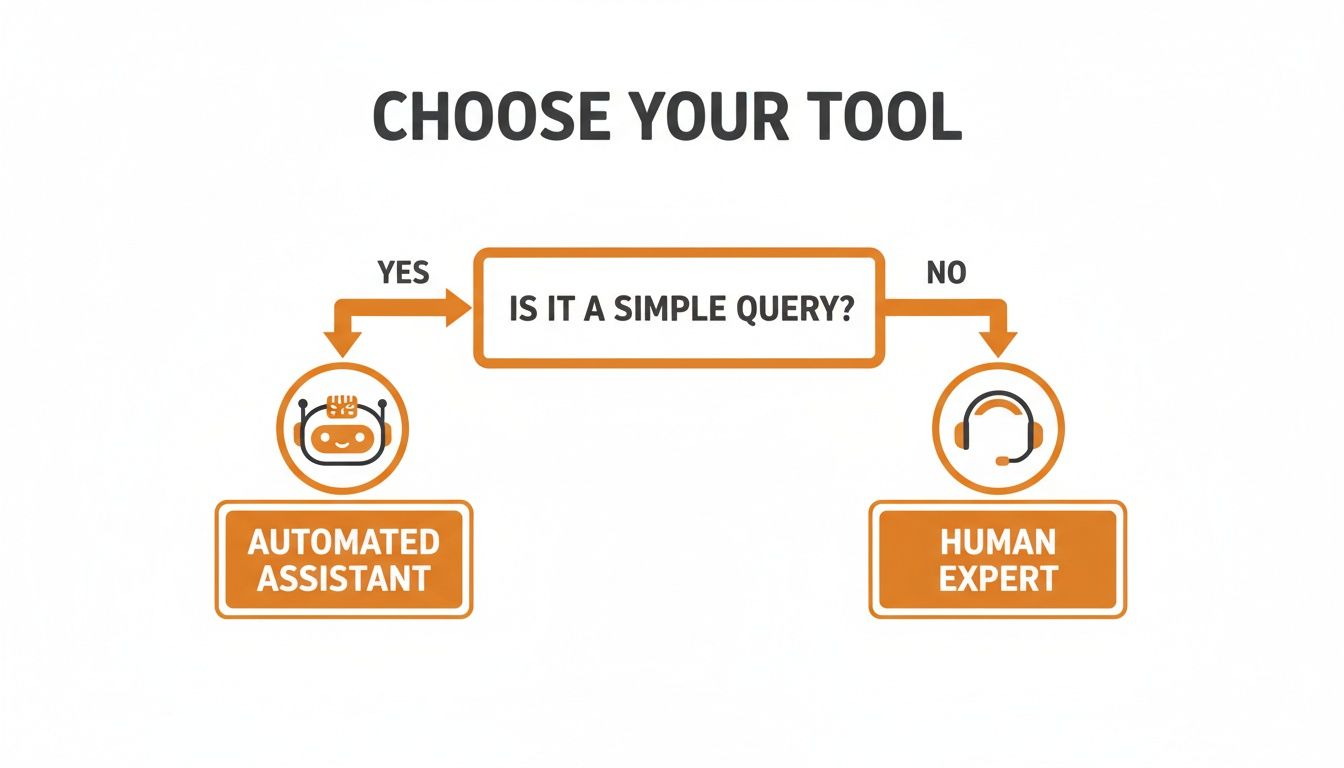
The key takeaway is that the customer's need should dictate the tool you use, which is why a hybrid approach offers the most flexibility.
Chatbot vs Live Chat At a Glance
Before we get into the nitty-gritty, let's look at a quick, high-level comparison. While chatbots are unbeatable for scale and cost-effectiveness, live chat shines when emotional intelligence and complex problem-solving are non-negotiable.
Here’s a simple table to see the fundamental differences at a glance.
| Feature | Chatbot / AI Agent | Live Chat (Human Agent) |
|---|---|---|
| Availability | 24/7, including holidays and weekends | Limited to agent schedules and shifts |
| Initial Cost | Lower long-term; SaaS subscription model | Higher; requires salaries, training, and benefits |
| Response Speed | Instantaneous, no wait times | Can involve wait times during peak hours |
| Best For | FAQs, lead qualification, appointment booking | Complex sales, sensitive issues, building rapport |
Ultimately, each has a clear role to play in creating a smooth and effective customer experience. It’s not about which is "better," but which is right for the specific task at hand.
Comparing Key Capabilities and Business Impact
Picking between a chatbot and a live chat agent isn't just about features. It’s a real business decision that hits your budget, your customer relationships, and how your team spends its time. The key is understanding how each one handles the day-to-day work and what that means for your bottom line.
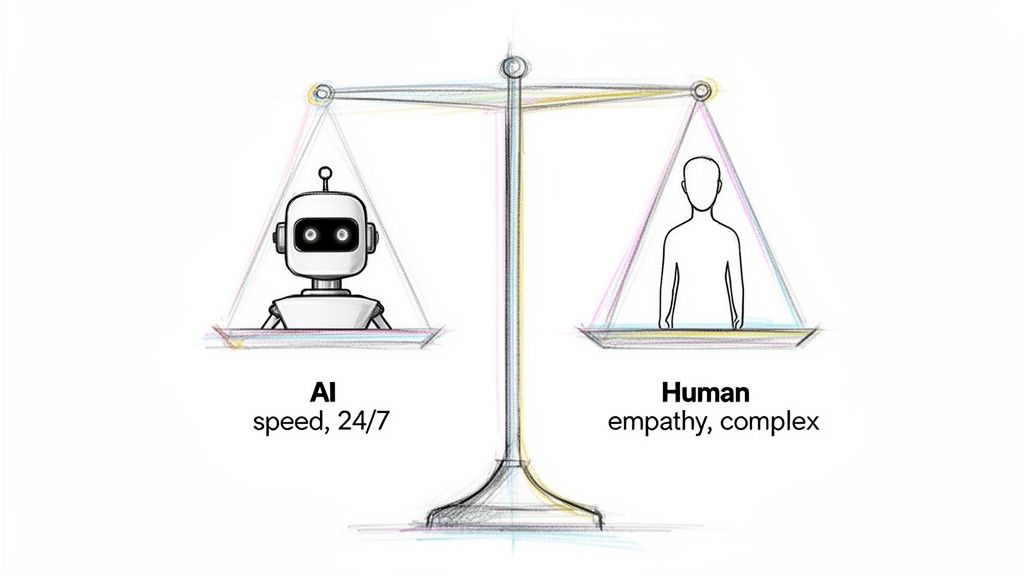
This isn’t about finding a one-size-fits-all "winner." It’s about weighing the trade-offs. You're balancing the raw efficiency of automation against the nuance of a personal human connection to see what fits your specific goals.
Response Speed and Availability
Here’s where the difference is night and day. One of the biggest reasons businesses look to chatbots is for instant, 24/7 support. Bots don’t sleep, they don’t take lunch breaks, and they certainly don’t get overwhelmed when a hundred people ask a question at once.
Automated systems are built for speed. A chatbot can fire back a response almost instantly—some data shows they're up to 3× faster than a human agent. For simple questions, the whole conversation can be over in under 5 seconds. For any business dealing with high volumes of repetitive questions, that’s a massive win. You can dig into more stats in this chatbot vs live chat data breakdown.
Live chat, on the other hand, runs on human time. Your team is great at what they do, but they have schedules and can only handle so many conversations at once. This means customers might get stuck in a queue during busy hours or have to wait until morning for an answer, which can be a real point of friction.
Quality of Interaction and Problem Solving
Now, let's flip the coin. When it comes to the quality of the conversation, the roles often reverse. A chatbot's greatest strength is its consistency. It will follow a script to the letter, every single time, which is perfect for routine tasks like answering FAQs or gathering basic contact info. We cover this in detail in our guide on using chatbots for lead generation.
But chatbots hit a wall when things get complicated or emotional. They can’t read between the lines, pick up on a customer’s frustration, or think outside the box to solve a problem they weren’t programmed for.
A live agent shines right where the script ends. They understand context, sense frustration, and come up with creative solutions on the fly. They can turn a potentially bad experience into a memorable, positive one.
This human element is absolutely critical in fields like law or medicine where sensitive information is involved. It’s also a game-changer for closing high-value deals where building trust is everything.
Cost Structure and Scalability
The money side of this decision is where things get really clear. The financial models for chatbots and live chat are worlds apart, and this is a core piece of the puzzle for any business.
Chatbot / AI Agent:
- Lower Operational Cost: You're typically looking at a predictable monthly subscription. That’s a fraction of the cost of salaries, benefits, and training for a full-time support team.
- Infinite Scalability: A single chatbot can talk to one person or a thousand people at the exact same time without breaking a sweat or costing you a dime more. It's built for growth.
Live Chat (Human Agent):
- Higher Human Capital Cost: The biggest expense is people. If you want 24/7 coverage, you need multiple agents working in shifts, which adds up fast.
- Limited Scalability: To handle more customers, you have to hire more people. There's a direct, linear relationship between your support volume and your payroll costs.
A chatbot delivers incredible cost efficiency for all the routine stuff, no question. But the ROI of a live agent is measured differently—it shows up in higher conversion rates on complex sales, better customer loyalty, and a stronger brand built on genuine human connection. The smartest play is often a hybrid one: let automation handle the volume to keep costs down, and save your human experts for the moments that truly count.
How Your Tools Talk to Each Other
Your chat tools can't live on an island. Real power comes from connecting them to the software you already use every day—your CRM, calendar, and even your phone system. This is where the gap between a simple chatbot and a true AI agent really widens.
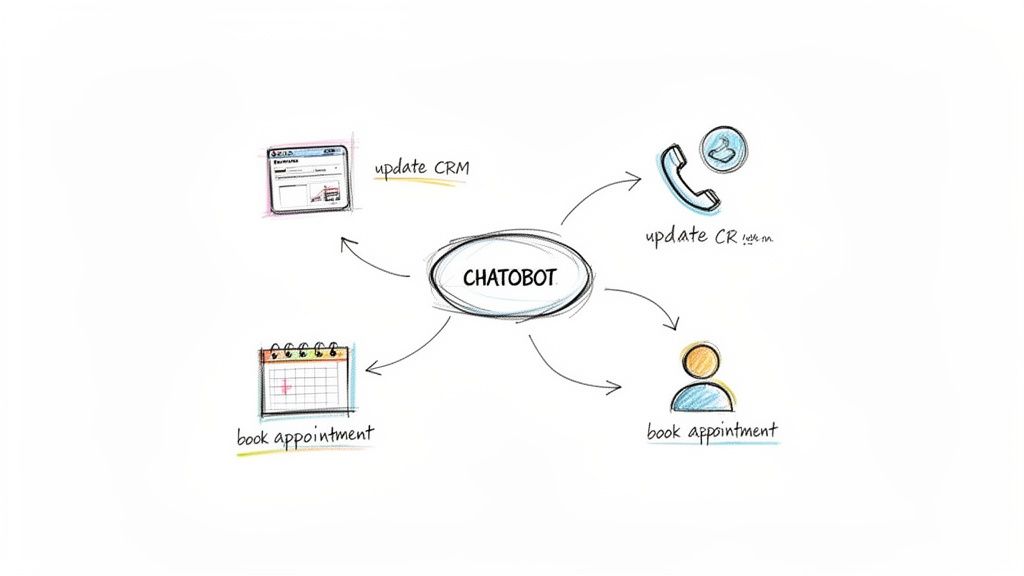
Think of a modern AI agent as more than just a conversationalist. It's a central hub for your entire workflow, capable of taking real action based on what a customer says. This ability to do things is what sets it apart.
AI That Does the Work For You
A properly integrated AI agent is built for action. It becomes a genuine part of your team, handling tasks that would otherwise fall on your plate.
Here’s how that looks for a real estate agent:
- A potential buyer calls your number after hours. An AI voice agent from CallCow picks up.
- It asks a few qualifying questions—budget, desired move-in date, etc.
- The AI then checks your live calendar availability and books a viewing appointment on the spot.
- To finish, it creates a new lead in your CRM, logs the call notes, and sets their status to "Viewing Scheduled."
That entire sequence happens without you lifting a finger. The AI isn't just passing a message along; it's an automation engine pushing your business forward 24/7.
The big difference here is that an integrated AI doesn't just give information to a human; it performs the task itself. This shifts the goal from simple communication to full-blown business automation.
Live Chat Integration: Arming Your Agents with Info
Live chat integrations work differently. Their main job is to give your human agents the context they need to do their jobs well. It's a support tool, not an independent worker.
When a customer initiates a chat, the system can pull their entire history from your CRM. Your agent instantly sees past purchases, support tickets, and contact info, all in one place.
This is huge for providing smart, personal support. The agent has the full story and can solve problems much faster. Many platforms can also create a new ticket in a helpdesk system like Zendesk once the chat is over. If you want to dive deeper into that, we have a whole guide on integrating a chatbot for Zendesk.
But notice the key difference: the human agent is still the one doing the work. The integration provides the data, but a person has to book the appointment, process the refund, or update the CRM. The workflow is human-led, whereas with AI, it's automation-led.
Real-World Scenarios for Your Industry
Knowing the theory behind chatbots versus live chat is helpful, but the real test is applying it to your own industry. What works for a real estate agency might not work for a law firm. The best choice always comes down to the customer's specific need and what's at stake in that conversation. Often, a hybrid approach gives you the best of both worlds—efficiency where it counts and a human touch when it matters most.
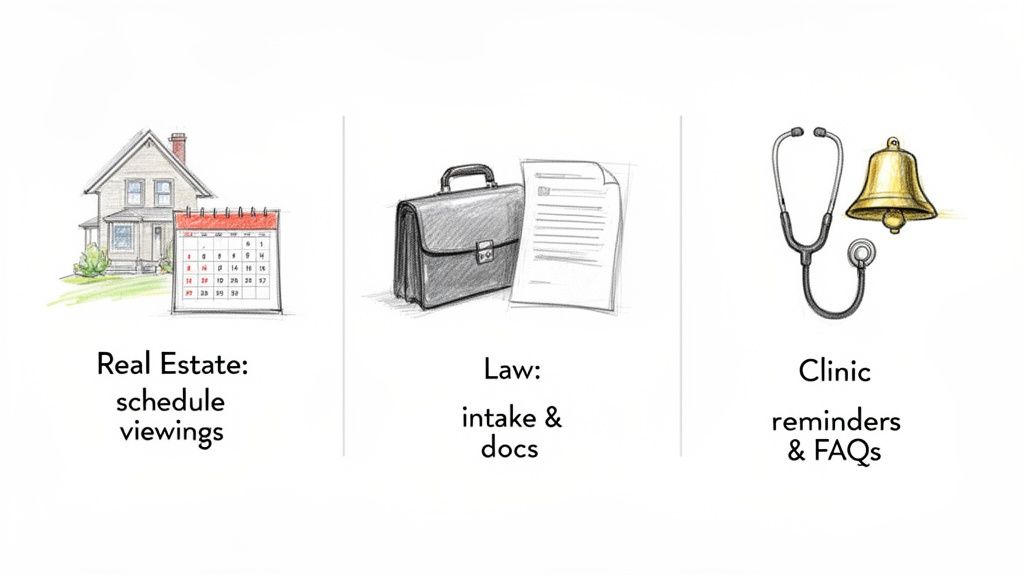
Let's walk through some practical scenarios in a few key sectors. We'll look at where automation is a clear winner and where a real person is absolutely irreplaceable. These examples should help clarify how you can build a smarter, more responsive system for your business.
Real Estate Agents and Brokerages
The real estate market is always on. Leads don't just come in between nine and five. For agents and brokerages, dividing tasks between an AI and a human agent isn't just a good idea—it's a powerful strategy for growth.
Use a Chatbot or AI Voice Agent For:
- After-Hours Inquiries: A prospect sees a listing at 11 PM and calls. An AI agent like CallCow can instantly answer, provide property details, and qualify their interest on the spot.
- Scheduling Viewings: Instead of just taking a message for you to handle in the morning, the AI can access your calendar and book a showing right then and there. It captures that hot lead while they're still excited.
- Answering Common Questions: The bot can field all the repetitive questions—"What are the school districts?" or "Are pets allowed?"—freeing you up for actual negotiations.
Use a Live Agent For:
- Negotiating Offers: This is where the art of the deal comes in. Closing requires nuance, persuasion, and reading the other person. That's a job for a human.
- Addressing Complex Concerns: When a buyer has detailed questions about an inspection report or financing contingencies, a live agent can provide the in-depth, reassuring answers that build trust.
- Building Client Relationships: The connection you build with a client is everything. It leads to referrals and repeat business. Those conversations are uniquely human.
Law Firms and Legal Services
In the legal world, efficiency and accuracy are non-negotiable. So are client confidentiality and trust. Automation can handle the administrative grunt work, letting legal professionals focus on providing expert counsel.
The key for legal practices is to automate the intake process, not the legal advice itself. This preserves the firm's resources for billable, high-value work that requires a licensed professional.
A chatbot is brilliant for the initial client intake. It can ask pre-qualifying questions to sort out the case type, securely collect initial documents, and schedule that first consultation. This ensures your paralegals and attorneys walk into the first meeting with all the necessary information.
But the moment a potential client seems distressed or starts discussing a sensitive matter, a human needs to step in. A live paralegal or intake specialist can provide the empathy and assurance an automated system just can't replicate during a difficult time.
Medical Clinics and Healthcare Practices
For clinics, patient experience and operational efficiency are two sides of the same coin. The right communication tools can slash administrative tasks while directly improving patient care. You can see just how well automation fits into a medical setting by exploring the various AI use cases for clinics.
An AI voice agent is perfect for handling appointment reminders, sending confirmation texts, and answering basic questions about clinic hours or locations. This simple step dramatically reduces no-shows and frees up your front desk staff from the phones.
However, when a patient calls with a specific medical concern, a question about their treatment plan, or a billing issue, a live receptionist or nurse is essential. These conversations require sensitivity, privacy, and professional judgment that automation can't provide. That human element ensures patients feel heard, understood, and cared for.
How to Measure ROI and Drive Real Growth
Picking between a chatbot and a live agent isn't just about service—it's a straight-up financial decision. You have to connect your choice to the bottom line, and that means tracking the right numbers to measure your return on investment (ROI). The trick is to realize that automation and human support drive growth in different, but equally powerful, ways.
When you bring in AI agents or chatbots, you’re playing a game of scale and efficiency. Their ROI comes from a pretty simple formula: cost savings. These tools can handle a massive volume of conversations for a tiny fraction of what it would cost to have humans do the same work. This makes their value easy to see in the numbers.
Measuring AI and Chatbot ROI
To justify bringing in automation, you need to focus on what it does best: saving you time and money. Look at the repetitive, predictable tasks you can offload and track the difference it makes.
Here are the core metrics to watch for AI agents:
- Cost-Per-Interaction: This is your bread and butter. Figure out what each automated chat costs and put it side-by-side with what you’d pay a human agent for the same conversation.
- Lead Qualification Rate: How many good leads is the AI actually identifying and handing off to your sales team? This shows its direct impact on your sales pipeline.
- Deflected Inquiries: Count how many simple questions your chatbot answers without ever needing a human. Every single one of those is a direct saving on labor costs.
Measuring Live Chat ROI
With live chat, the ROI story is all about making money and building relationships. Yes, it costs more for each conversation, but a talented agent can turn a casual question into a big sale or an unhappy customer into a loyal fan. Here, you’re measuring value in conversions and customer happiness.
Proactive live chat isn't just a nice-to-have; it can deliver a massive 305% ROI. Companies that get it right have seen a 48% increase in revenue per chat hour and a 10% bump in average order value (AOV) when an agent steps in with the right help at the right time. You can dig into more stats on live chat’s financial impact.
For live chat, you’ll want to track metrics like:
- Conversion Rate: How many chats actually result in a sale, a booked demo, or a new sign-up? This is the most direct measure of revenue.
- Average Order Value (AOV): Compare the spending of customers who use live chat versus those who don't. A good agent is an expert at upselling and cross-selling.
- Customer Satisfaction (CSAT) Scores: A quick post-chat survey can tell you how happy your customers are. High CSAT scores are a great predictor of loyalty and repeat business.
In the end, the chatbot vs. live chat ROI debate isn't about which one is "better." It's about how they work together. Automation gives you incredible cost savings by handling the high-volume, simple stuff. Meanwhile, live chat shines when it comes to driving revenue from more complex, high-value conversations. The smartest approach uses both to create a system that’s both cost-effective and profitable.
Building Your Optimal Hybrid Communication System
<iframe width="100%" style="aspect-ratio: 16 / 9;" src="https://www.youtube.com/embed/dZ6n0byNvRA" frameborder="0" allow="autoplay; encrypted-media" allowfullscreen></iframe>The whole "chatbot vs. live chat" debate often misses the real opportunity. The smartest play isn't picking a side; it's building a hybrid system where automation and human expertise work in tandem. The goal is simple: automate the predictable so your team can focus on the exceptional.
A hybrid model ensures you have the right tool for every customer interaction. Let AI handle the repetitive, high-volume questions that come in around the clock. This frees up your human experts for the conversations that truly need a personal touch—the ones that require empathy, negotiation, or complex problem-solving. It’s a win-win, creating a smoother experience for clients and a more productive workflow for your team.
Crafting a Hybrid Workflow
The first step is to sit down and map out your typical customer journey. Where do people get stuck? What are the most common questions? This isn’t just about saving time; it’s about strategically placing the right resource at each step to get the best result.
Here’s what a typical hybrid flow looks like in action:
- First Point of Contact: An AI agent is your 24/7 frontline greeter. It’s always on, ready to answer basic questions, qualify new leads, and direct inquiries to the right place, ensuring you never miss a potential client.
- Automated Action: The AI does more than just chat. It can schedule appointments directly onto your calendar, collect intake information, and get the ball rolling before a human ever steps in.
- Seamless Escalation: When a conversation gets too complicated or a customer signals they're ready to buy, the system intelligently hands off the chat to a live agent. Crucially, the full conversation history goes with it, so your team member has all the context.
- Human Connection: Your team steps in for the high-stakes moments—closing a deal, navigating a sensitive client issue, or building a relationship that leads to long-term business.
This approach leans into the undeniable scaling power of automation. For example, some e-commerce sites using chatbots can now handle 89.2% of inquiries and manage a 6x higher conversation volume. This highlights how automation can dramatically cut costs while expanding your reach, as shown in these live chat vs AI chatbot findings.
The ideal system uses AI as both a gatekeeper and an accelerator. It filters the noise, handles the routine tasks, and perfectly tees up qualified, high-value conversations for your human team.
Bridging the Gap with AI Voice Agents
This is where a tool like CallCow completely changes the game. An AI voice agent is the perfect bridge in a hybrid model, offering the instant, 24/7 efficiency of a chatbot but with the more personal, familiar feel of a phone call.
Think of it as your first line of defense. It can answer calls, qualify leads, and book appointments day or night, freeing your team to do what they do best: build relationships and close business.
Common Questions, Straight Answers
Let's cut right to it. When you're deciding between a chatbot and a live human agent, you probably have some of these questions on your mind. Here are some direct answers based on what we've seen work for thousands of businesses.
Can a Chatbot Actually Replace My Human Team?
Short answer: No, and you wouldn't want it to. A chatbot is a powerful supplement to your team, not a replacement. It’s designed to handle the high-volume, repetitive stuff that bogs your people down—things like answering basic FAQs, tracking orders, or qualifying new leads around the clock.
Think of it as a force multiplier. The AI handles all the predictable, tedious tasks. This frees up your human agents to focus on the complex, high-value conversations where genuine empathy and advanced problem-solving skills are critical. It’s about letting technology do what it does best so your people can do what they do best: build relationships.
What’s the Real Difference in Cost?
The financial models couldn't be more different. Chatbots and AI agents usually run on a predictable, scalable subscription (SaaS) model. This is almost always cheaper than hiring, training, and paying salaries for enough live chat agents to provide the same level of coverage. One AI subscription can manage countless conversations at once; scaling live chat means hiring more people.
While a great human agent drives ROI through high-touch sales and complex problem-solving, chatbots deliver their ROI through pure operational efficiency. They dramatically lower the cost-per-interaction for all those routine but necessary customer touchpoints.
How Do I Decide What to Automate?
The best rule of thumb is to automate anything that’s predictable, data-driven, and follows a clear set of steps. A great place to start is by looking at your most frequent support tickets or chat logs and automating the top 20% of those questions.
Good Candidates for Automation:
- Answering common questions like "What are your business hours?"
- Booking appointments and scheduling demos right on your calendar.
- Qualifying new leads by asking a few simple questions (e.g., budget, timeline).
- Providing instant order status or shipping updates.
Save These for Your Human Agents:
- Handling billing disputes or tricky account-related problems.
- Navigating nuanced sales negotiations or overcoming specific objections.
- Managing emotionally charged conversations with upset or sensitive clients.
- Giving personalized, high-level advice that requires deep expertise.
Ready to see how an AI voice agent can handle your calls 24/7, qualify leads, and book appointments automatically? See what CallCow can do for you at https://callcow.ai.