Choosing a Law Firm Phone Answering Service
Discover how a law firm phone answering service can capture leads and improve client intake. Learn how to choose, set up, and optimize the right service.For any law firm, the phone ringing is the sound of opportunity. But what happens when no one is there to answer it? A law firm phone answering service steps in to make sure every single one of those calls gets a professional, human response. It’s your firm's frontline, handling everything from new client intake to scheduling appointments, 24/7. This frees up your legal team to focus on what they do best: practicing law.
The Financial Reality of Unanswered Calls
Let's be blunt: for most law firms, the phone is the main artery for new business. Each ring is a potential client, often reaching out during a stressful, urgent time in their life. When that call goes unanswered, it's more than a missed connection. It's revenue you just handed directly to your competition.
Today's clients just don't wait. We're not in an era where people patiently leave a voicemail and hope for a call back. They expect an immediate answer, and if they don't get it from you, they have a dozen other options a quick Google search away. Voicemail is where good leads go to die; an eye-opening 80% of callers hang up the second they hear an automated message and immediately dial the next firm on their list.
Why Every Call Is a Revenue Opportunity
This isn't just a hunch; the data tells a brutal story. The legal industry has a massive communication problem. Law firms across the U.S. field about 557 million calls annually, but a shocking 35% of them are never answered.
Do the math on that. It adds up to roughly 195 million missed calls, which could mean losing out on as many as 13.6 million new clients every single year. The financial fallout is staggering—an estimated $109 billion in potential revenue is lost simply because the phone wasn't picked up. As highlighted in research from LawLeaders.com, this points to a fundamental breakdown where a firm's responsiveness is directly tied to its bottom line.
In the legal world, speed is everything. The firm that answers the phone first is almost always the firm that gets hired. Missing a call isn't just bad service—it's actively sending business to your competitors.
This simple diagram shows exactly what happens when a potential client’s call goes to voicemail. It’s a costly journey.
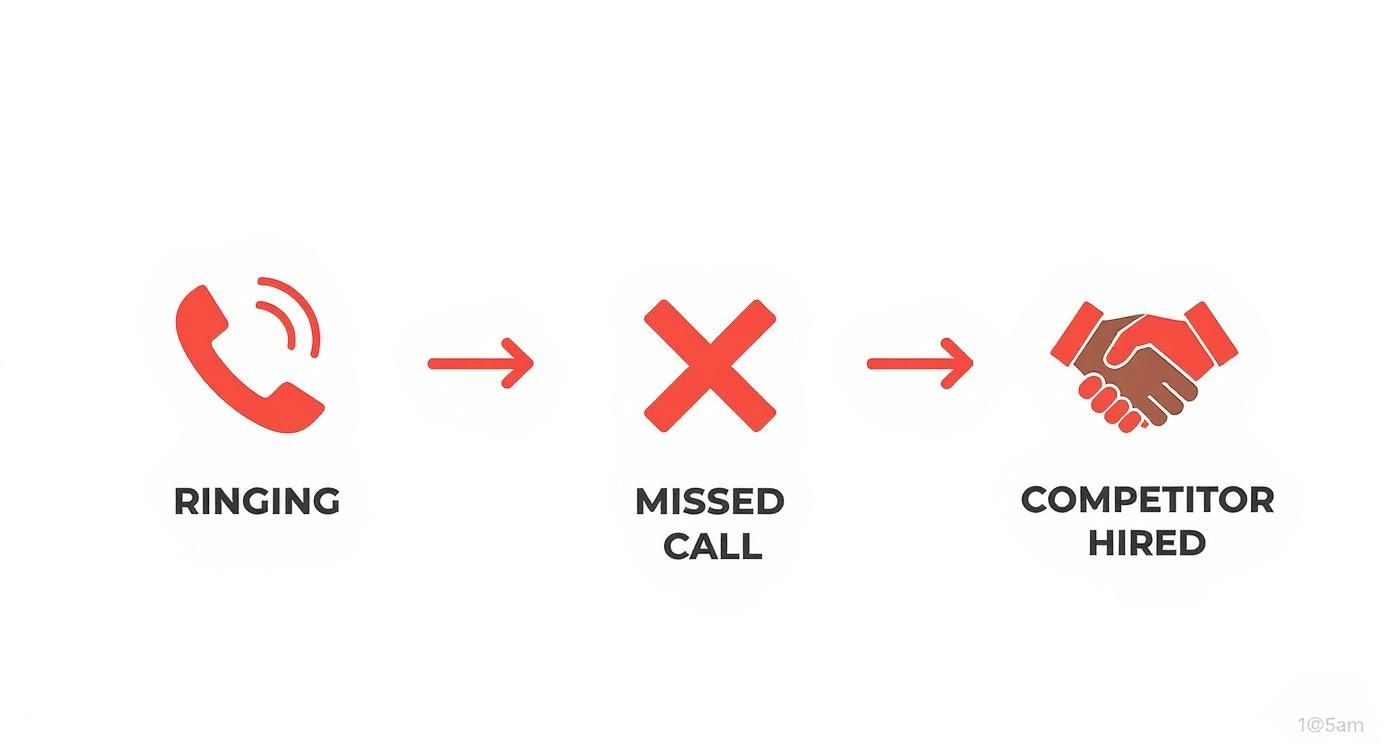
As you can see, that one missed call sends a potential client right back into the open market, where they're quickly snapped up by the next firm that bothers to answer.
Quantifying the Damage
Stop and think about the lifetime value of just one client. A single new case in your practice area could easily be worth thousands, if not tens of thousands, of dollars. Now, be honest: how many calls does your firm miss during lunch, after 5 PM, or over the weekend?
The costs go deeper than you might think:
- Lost Client Acquisition: This is the most direct hit. Every unanswered call from a prospect is a retainer you'll never see.
- Wasted Marketing Spend: You pour money into SEO, pay-per-click ads, and networking to make that phone ring. When a call isn't answered, you've essentially thrown that marketing investment away.
- Damaged Firm Reputation: What does an unanswered phone say about your firm? It suggests you're disorganized, overwhelmed, or simply don't prioritize new clients. That perception can kill your reputation and dry up referrals.
Viewing a law firm phone answering service as just another expense is a mistake. It's a strategic investment in growth. It patches a major leak in your client acquisition pipeline, ensuring every marketing dollar pulls its weight and every potential client feels valued from the very first hello.
Auditing Your Firm’s Communication Needs
Jumping into a contract with a law firm phone answering service without first understanding your firm's specific needs is like buying a car without knowing if you need a truck or a sedan. The right solution starts with a deep, honest audit of your current communication workflow—or the lack of one. This isn't just about counting missed calls; it's about mapping the entire client journey from the first ring to the initial consultation.
The goal here is to move from gut feelings to hard data. You might feel like afternoons are your busiest time, but your phone logs could reveal a surge of calls right at 8:30 AM from potential clients trying to connect before their own workday begins. A thorough audit gives you a clear blueprint of your requirements, ensuring you choose a service that solves your actual problems, not just the ones you guess you have.

Pinpointing Peak Call Times and Volumes
First things first: you need to understand the rhythm of your firm’s communications. Your phone system’s call logs are a treasure trove of information just waiting to be analyzed. Pull reports for the last 30 to 90 days and start looking for patterns.
Start by digging into these questions:
- When do most calls come in? Look for the specific days of the week and times of day that are consistently busy. You might find a predictable spike right after you launch a new marketing campaign or every Monday morning like clockwork.
- What is your call abandonment rate? This is the percentage of callers who hang up before anyone answers. A high rate is a massive red flag, signaling that your team is swamped and potential clients are simply giving up and calling your competitor.
- How many calls go straight to voicemail? Break this down between business hours and after-hours. A high number of voicemails during the workday points to a staffing issue, while a flood of after-hours calls represents a completely untapped opportunity.
This analysis will immediately show you where the biggest leaks are in your pipeline. If you discover that 30% of your calls are missed between 12 PM and 2 PM, you don't just need an answering service—you need one that can reliably cover your lunch hour without fail.
Identifying Your Most Common Call Types
Let's be real, not all calls are created equal. A new lead requires a completely different approach than a current client asking for a quick update or opposing counsel calling about a case. Segmenting your inbound calls is crucial for designing an effective call-handling process for your future answering service.
Review your call logs, messages, and even just your team’s memory to categorize the inquiries you typically receive. Think about buckets like these:
- New Client Inquiries: These are your highest-value calls, period. How many do you get per week? What information is absolutely essential to capture during this first interaction?
- Existing Client Questions: These callers need reassurance and quick answers. How often do they call for case updates, and could a service be trained to handle basic status checks?
- Court and Opposing Counsel Calls: These require immediate and specific routing to the right person. What is your current process for escalating these time-sensitive communications?
- General/Administrative Calls: This is the catch-all for everything from vendors to wrong numbers. How much of your team's valuable time is wasted on these low-value interruptions?
By categorizing your calls, you can create a clear hierarchy. This lets you instruct an answering service to prioritize new leads for immediate intake while efficiently handling routine inquiries by taking a simple message.
Mapping Your Current Intake Workflow
Finally, it's time to map out what happens—or what should happen—when a potential new client calls. Be brutally honest with yourself here. Does the call go to a dedicated receptionist, or does it ring every phone in the office until a stressed-out paralegal finally picks it up?
Trace the journey from start to finish. For many firms, it looks something like this:
- The phone rings. And rings.
- A paralegal answers on the fourth ring, sounding flustered.
- They try to get basic contact info while juggling another urgent task.
- They jot down notes on a random sticky pad.
- They promise an attorney will call back "as soon as possible."
- That sticky note gets lost under a pile of paperwork.
This simple exercise will expose every single bottleneck and point of friction. It shows you precisely where opportunities are falling through the cracks and builds a compelling business case for a streamlined, professional process handled by a dedicated law firm phone answering service. With this complete audit in hand, you’re finally ready to find a service that perfectly matches your firm’s unique pulse.
Designing Effective and Compliant Intake Scripts
Your law firm phone answering service is only as good as the script you give them. A great script transforms a virtual receptionist into a skilled intake specialist—someone who can capture vital information, build instant rapport, and shield your firm from serious compliance headaches.
A bad script, however, makes a potential client feel like they're talking to a robot. It’s clunky, impersonal, and the fastest way to get them to hang up and dial your competitor. The real goal is to create a guided conversation, not an interrogation. This is especially true for sensitive fields like personal injury or family law, where callers are often stressed and vulnerable.
The Foundation of a Great Intake Script
Every solid legal intake script is built on the same principles: it must be clear, concise, and empathetic. It also needs a logical flow that guides both the receptionist and the caller, ensuring no critical details slip through the cracks.
Think of it as building a house. You need a solid foundation before you can put up the walls.
- A Professional Opening: The very first thing the receptionist should do is state your firm's name clearly. A simple "Thank you for calling [Your Law Firm Name], how can I help you?" instantly confirms they've reached the right place and sets a professional tone.
- Essential Contact Details: This is non-negotiable. The script must prompt for the caller's full name, phone number, and email address. I also recommend asking for the best time for an attorney to call them back.
- The Reason for the Call: The script needs to uncover why they are calling. Is it a new car accident case? A question about a child custody agreement? This simple step is crucial for qualifying the lead and getting it to the right person on your team.
Navigating the Compliance Minefield
One of the biggest pitfalls in client intake is accidentally creating an attorney-client relationship before you’ve even run a conflict check. Your script is your first and best defense against this exact scenario.
It is absolutely essential that your script includes a clear, explicit disclaimer for the receptionist to read to every new potential client.
A well-placed disclaimer is non-negotiable. Instruct your answering service to state clearly: "Please be aware that I am not an attorney and cannot provide legal advice. Our conversation today does not create an attorney-client relationship."
This one sentence is a powerful tool. It manages the caller's expectations from the get-go, clarifies the receptionist's role, and prevents someone from later claiming they received legal counsel during that initial call. Skipping this step can lead to serious ethical trouble and even malpractice claims down the road.
To make sure your intake process is airtight, every script should include these key elements.
| Script Component | Purpose | Example Phrase |
|---|---|---|
| Warm Opening | Establishes professionalism and confirms the firm's identity. | "Thank you for calling Smith & Jones Law. My name is [Name], how can I help you?" |
| Information Gathering | Captures essential contact details for follow-up. | "To get started, may I have your full name and the best phone number to reach you?" |
| Nature of Inquiry | Qualifies the lead and identifies the legal issue. | "Could you briefly tell me what type of legal matter you're calling about today?" |
| Conflict Check Info | Gathers names of opposing parties to prevent conflicts of interest. | "To run a standard conflict check, could you please provide the full name of the other party involved?" |
| Crucial Disclaimer | Prevents the unintentional formation of an attorney-client relationship. | "Just so you are aware, I am not an attorney and cannot provide legal advice." |
| Closing & Next Steps | Manages expectations and outlines what will happen next. | "Thank you for sharing that. I have all your information, and one of our attorneys will review it and call you back within 24 hours." |
Having these components in place ensures a consistent, compliant, and effective experience for every caller.
Customizing Scripts for Your Practice Area
A generic, one-size-fits-all script just doesn't work for law firms. To properly qualify leads and show callers you understand their specific needs, you have to tailor your questions to your practice area.
Personal Injury Script Example: For a potential PI client, you need to gather specific details without overwhelming them.
- Key Qualifying Questions:
- "Can you briefly tell me the date the incident occurred?"
- "What type of incident was it (e.g., car accident, slip and fall)?"
- "Were you injured, and did you receive medical treatment?"
- "Have you spoken with any other attorneys about this matter?"
Family Law Script Example: Calls about family law are often emotionally intense. The script must be empathetic while still capturing the necessary facts.
- Key Qualifying Questions:
- "Are you calling about a divorce, child custody, or another family law matter?"
- "Are there minor children involved?"
- "What is the name of the other party involved? (This is for our conflict check.)"
- "Has anything been filed with the court yet?"
Using Branching Logic for Smarter Conversations
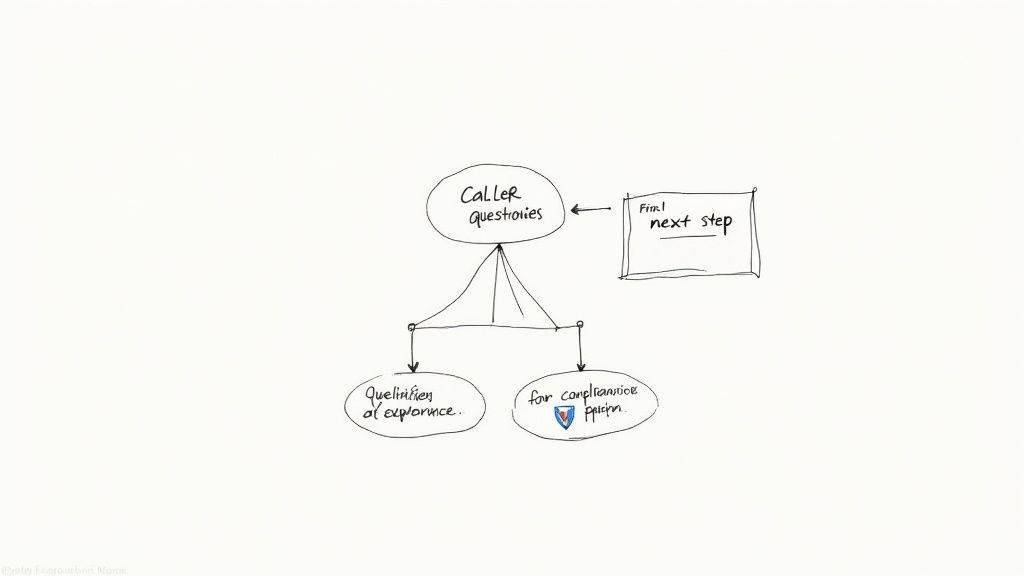
Your script shouldn’t be a rigid, linear document. The best intake scripts today use branching logic—which is really just a structured way of handling "if-then" scenarios. This allows the conversation to adapt in real-time based on a caller's answers.
For example, if a caller identifies themselves as an existing client, the script can immediately branch to a different set of questions ("What is your case number?" or "Which attorney are you working with?") before routing the call. If they’re a new lead, the script continues down the standard intake path.
This simple technique ensures every single caller gets the most efficient and relevant experience, turning your law firm phone answering service into a truly intelligent extension of your team.
Weaving Your Answering Service into Your Firm's Tech
Think of a top-tier law firm phone answering service as more than just a message-taker. It should be a central hub, plugged directly into your firm's operational core. When your answering service and your tech stack are in sync, you completely sidestep the tedious, error-prone drudgery of manual data entry. What you get is an automated workflow where new client information flows securely from that first call straight into your case management system.
The difference is staggering. Forget deciphering a jumbled email with a new lead's details. Instead, picture a new contact record popping up instantly in your CRM, already populated with notes from the initial call. This isn't some far-off idea; it's a practical move that turns your answering service into a client intake powerhouse.

Connecting to Your Legal CRM
The single most important integration is with your Client Relationship Management (CRM) or practice management software. Let's be honest, tools like Clio, PracticePanther, MyCase, and Filevine are the lifeblood of a modern firm. Your answering service has to talk to them.
When they’re connected, a virtual receptionist can field a call from a potential new client and, by following your intake script, instantly create a new contact or matter in your system. This one action immediately sets your firm's internal processes in motion.
- No More Manual Entry: Information zips over automatically. This eliminates typos and makes sure critical details like names and phone numbers are captured correctly from the get-go.
- Instant Lead Tracking: The second the call ends, that new lead is logged in your system, ready for a conflict check and assignment. Nothing ever gets buried in an email inbox again.
- Consistent Data: You can finally guarantee that every new lead is created with the same essential data points, which makes your reporting and follow-up incredibly reliable.
Picture this: a potential client calls about a car accident. The virtual receptionist runs through your script, and before the call even disconnects, a new contact and matter are created in Clio. It's automatically tagged "New PI Lead," with all the initial details attached. Your intake team gets a notification to start their follow-up. That’s what a proper integration does.
Automating Consultation Scheduling
The next game-changer is linking the service to your firm's calendar. That back-and-forth email chain just to schedule a consultation? It’s a massive time-waster and a real point of friction for potential clients. An integrated answering service kills that problem dead.
Give your service secure, read-only access to your attorneys' availability through a tool like Calendly or directly with Google Calendar or Outlook. From that moment on, virtual receptionists can book consultations for you in real time.
Here’s how it works:
- A qualified lead is on the line and wants to book a meeting.
- The virtual receptionist sees your attorney’s live availability.
- They book the appointment right on the calendar, right there on the call.
- Confirmation messages are automatically fired off to both the client and the attorney.
This simple workflow drastically cuts the time from first contact to a scheduled meeting, which can give your conversion rates a serious boost. This kind of immediate engagement is more critical than ever. Recent industry data revealed that law firms' call-answering rates have tanked, dropping from 56% in 2019 to just 40% in 2024. This has created a huge "accessibility gap."
With 35% of potential clients admitting they won't leave a voicemail and just call the next firm on their list, immediate scheduling is a massive competitive edge. You can dig into how firms are tackling this problem in this insightful legal tech analysis.
Setting Up Your Integration Workflow
Getting this all up and running is probably more straightforward than you think. Most reputable answering service providers offer native, one-click integrations with the major legal software platforms. They'll walk you through connecting your accounts as part of their onboarding.
The key is to define the rules of engagement for these integrations ahead of time. You'll need to decide exactly what information gets synced, what action triggers the creation of a new contact, and which calendar the service should use for booking. A little bit of planning upfront ensures the automated workflow fits perfectly with how your firm already operates, making your technology a true client-acquisition asset.
How to Measure Answering Service Performance and ROI
Once you’ve got a law firm phone answering service up and running, the real work begins. It’s one thing to have the service active, but it’s another thing entirely to know if it’s actually paying for itself. To justify the investment and dial in its performance, you have to look beyond a simple call count.
The goal is to prove the service's value with hard data—the numbers that directly link what the receptionists are doing to your firm's bottom line. Is the service just taking messages, or is it actively generating new business? A well-managed service should be a revenue driver, not just another monthly expense.
https://www.youtube.com/embed/hujuNURpGno
Pinpointing Your Key Performance Indicators
Before you can measure success, you have to define what it actually looks like for your firm. Every practice is unique, but a few key performance indicators (KPIs) are universally critical for understanding how effective your answering service truly is. Don't get bogged down in a swamp of data; focus on the metrics that tell the real story.
Here are the core KPIs you should be tracking from day one:
- Call-to-Consultation Rate: This is the big one. It tells you exactly what percentage of new potential client calls turn into a booked consultation. If this number is low, it’s a red flag that something might be off with your intake script or how the receptionists are handling the calls.
- Lead Qualification Accuracy: How many of the leads being sent your way are genuinely a good fit? You need to track how often the service correctly identifies a potential client who matches your criteria versus someone who needs a referral or isn't a match at all.
- After-Hours and Weekend Capture Rate: This is where the 24/7 service really proves its worth. Measure how many qualified leads you’re capturing outside of your standard 9-to-5 business hours. For many firms, this is where the most immediate and obvious ROI comes from.
Keeping a close eye on these numbers helps you spot trends and fix problems before they get out of hand. For example, if your call-to-consultation rate starts to dip, it’s probably time to revisit your intake script and see if you can sharpen the qualifying questions.
Don't mistake activity for progress. A hundred answered calls is just a vanity metric if none of them become clients. The objective isn't just to answer the phone—it's to convert callers into consultations.
Calculating the True Return on Investment
Figuring out the ROI of a phone answering service isn't just about the new clients you sign. It’s a mix of tangible financial gains and the less obvious, but equally important, operational efficiencies. A solid ROI analysis will give you the full picture of the service’s impact.
Start with the direct costs—the monthly fees, any overages, the whole package. Then, stack that cost up against the value it’s creating.
Here’s how to break it down:
- Revenue from New Clients: You need a system to track every single client that came from a call handled by the service. Multiply the number of those new clients by your firm's average case value. That’s your direct revenue.
- Hours Saved on Administrative Tasks: Think about all the time your in-house staff saves by not having to answer phones, screen calls, and schedule appointments. Multiply those saved hours by their hourly rate to see the value of that reclaimed productivity.
To get a clear picture of your answering service's impact, you need to track the right metrics. These KPIs will help you measure effectiveness, identify areas for improvement, and ultimately understand the return on your investment.
| Metric | What It Measures | Industry Benchmark |
|---|---|---|
| Call-to-Consultation Rate | The percentage of new caller inquiries that result in a scheduled consultation. | 30% - 45% |
| Lead Qualification Accuracy | How often the service correctly identifies and forwards a qualified lead. | > 95% |
| Average Speed to Answer | The average time it takes for a receptionist to answer an incoming call. | < 20 seconds |
| After-Hours Lead Capture | The number of qualified leads captured outside of standard business hours. | Varies, but should show significant lift over pre-service numbers. |
| Cost Per Qualified Lead | The total service cost divided by the number of qualified leads generated. | Varies by practice area and marketing spend. |
By consistently monitoring these KPIs, you can move beyond gut feelings and make data-driven decisions to optimize your intake process and maximize your firm's growth.
The rise of AI and virtual receptionists is making this math even more attractive. Many modern services provide dashboards that track KPIs like lead-to-consultation conversion rates, which often land between 30–45%. In fact, firms that actively monitor these metrics report a 34% higher ROI than those who only glance at call volume. By automating parts of the intake process, firms can cut costs by up to 70% while generating 35–50% more client conversions.
For many law practices, signing just one or two extra clients a month is more than enough to cover the entire cost of the service. You can learn more about the real financial impact by reading about the cost of missed calls for solo attorneys in 2025.
When you regularly review these numbers and calculate your ROI, you can make informed, strategic decisions. This approach lets you fine-tune your scripts, give specific feedback to your receptionists, and confidently prove that your investment is directly contributing to your firm's success.
Common Questions About Legal Answering Services
Even when you see the clear benefits, bringing a law firm phone answering service into the fold naturally raises some questions. I've seen firms wrestle with everything from the cost and data security to the big one: how can a third party really handle a complex legal call? Getting solid answers here is the key to making a move you feel good about.
Let's tackle the most common questions I hear from attorneys, so you can get the clarity you need.
How Much Does a Law Firm Phone Answering Service Cost?
This is always the first question, and the honest answer is: it depends. The price tag is almost always tied to two things: how many calls you get and how much you need the service to do. Most providers have a few standard ways they structure their pricing.
You'll typically see monthly plans broken into tiers. These can start around $200 for basic after-hours coverage and go up to $1,500 or more for premium 24/7 support that includes things like deep CRM integration and appointment setting. Some companies also offer per-minute billing, which can be a decent option if your call volume is all over the map.
Here's how I tell firms to think about it: weigh the monthly cost against the value of just one new retained client. For most practice areas, if the service helps you land just one more case a month, it's already paid for itself. It stops being an expense and becomes a profit-generating tool.
How Is Client Confidentiality Handled by a Third Party?
Protecting client confidentiality is paramount. It’s a completely valid concern when you're thinking about letting an outside service interact with your potential and current clients. The good news is that any reputable legal answering service is built with security and discretion as its foundation.
Their receptionists go through rigorous training on the fundamentals of attorney-client privilege and are bound by strict non-disclosure agreements (NDAs). On the tech side, all communications—from call recordings to messages—are handled on secure, encrypted platforms to shield that sensitive information from any threats.
Before you sign anything, make sure you grill a potential provider on their security protocols. You should be asking about:
- How they train their staff on legal ethics and privacy.
- Their specific data encryption standards (both for data in transit and at rest).
- What kind of physical security they have at their call centers.
- Their compliance with regulations like HIPAA, if your firm handles personal injury or medical malpractice.
A partner worth their salt will be an open book about this stuff and happily provide all the documentation you need.
What if a Call Is Too Complex for a Virtual Receptionist?
This is a great question, and it gets to the heart of how these services actually work. An effective answering service doesn't just wing it; they operate on a detailed escalation plan that you create with them during the onboarding process. Their job isn't to give legal advice—it's to be an incredibly efficient screener and dispatcher.
For truly urgent situations, like a call from opposing counsel or an existing client with a genuine emergency, the receptionist follows your script. They'll gather the critical details and immediately transfer the call directly to the right attorney or paralegal's cell phone.
But for those calls that are complex but not an emergency, they'll take a thorough message, mark it as high priority, and—this part is crucial—let the caller know exactly when they can expect to hear back from someone at the firm. This manages the caller's expectations perfectly, making them feel taken care of even when their problem needs an attorney’s direct involvement.
Article created using Outrank