
Virtual Assistant for Real Estate: Boost Productivity and Close More Deals
Explore how a virtual assistant for real estate can streamline tasks, save time, and help you close more deals with AI and expert VAs.In real estate, your most valuable asset isn't a property—it's your time. Every minute you spend buried in paperwork, wrestling with your calendar, or entering data into a CRM is a minute you're not spending with a client or closing a deal. This is exactly where a virtual assistant for real estate comes in, acting as a force multiplier for everything you do.
Think of them as a skilled sous chef in a busy kitchen. While you, the head chef, are focused on the main course—negotiations, client strategy, and sealing the deal—your VA is handling all the essential prep work that keeps the whole operation from falling apart. This kind of support isn't a luxury anymore; for agents who want to scale, it's a necessity.
Your Secret Weapon for Real Estate Growth
The core idea is simple: delegate the tasks that eat up your day so you can focus on the activities that actually make you money. An effective VA, whether human or AI, takes over the critical but time-consuming responsibilities that are the bedrock of any successful real estate business.

Why VAs Are Such a Game-Changer
By delegating strategically, you shift from being reactive—constantly putting out fires—to being proactive. Instead of being stuck behind a desk managing administrative tasks, you're out in the field building the relationships that grow your business.
This isn't just a niche trend; it's a massive shift in how the industry operates. The global market for real estate virtual assistants was valued at USD 0.4 billion in 2023 and is expected to nearly double, hitting USD 0.75 billion by 2032. That explosive growth shows just how essential VAs have become for agents who need a cost-effective way to stay competitive.
What Can a Real Estate VA Actually Do for You?
So, what can you hand off? A good VA can manage a surprisingly wide range of tasks that directly impact your bottom line, freeing you from the back-office grind and letting you shine in front of clients.
To give you a clearer picture, here are some of the primary responsibilities a VA can take off your plate almost immediately.
Key Tasks to Delegate to Your Real Estate VA
| Task Category | Example Activities |
|---|---|
| Lead Management | Qualifying new leads from Zillow or your website, nurturing contacts, logging interactions in the CRM. |
| Administrative Support | Managing your calendar, booking appointments and showings, preparing transaction paperwork. |
| Marketing Operations | Creating and scheduling social media posts, updating property listings, managing email campaigns. |
| Client Communication | Sending follow-up emails and texts, answering routine questions, scheduling initial calls. |
By offloading these responsibilities, you get your time back to focus on what really moves the needle. Smart AI solutions like CallCow are taking this even further, automating tasks that once required a human touch. Explore how top realtors are using AI VAs to gain a serious competitive edge. This isn't just about working harder; it's about working smarter.
So, What Does a Real Estate VA Actually Do?
When agents hear "virtual assistant," it's easy to think of it as just generic "help." But to really get the value, you have to get specific. Let's break it down. Think of your real estate business as having three core engines that need to run perfectly for you to move forward.
A great VA acts like an expert mechanic for each of these engines. They keep things humming in the background so you can stay in the driver's seat, focused on what you do best: closing deals.
These engines are Lead Management, Administrative Operations, and Marketing Support. When you hand these over to a VA, you’re not just delegating tasks; you're building a system that frees you up for the high-value work—like face-to-face meetings and negotiations—that actually makes you money.

The Lead Management Powerhouse
Every single inquiry—whether it comes from Zillow, your website, or a Facebook ad—is a potential commission check. The problem? Leads go cold fast. If you’re in a showing or meeting with a client, you can't possibly respond instantly. That's a huge missed opportunity.
This is where a virtual assistant becomes your front line. They can engage with new contacts the moment they come in, ask those first crucial qualifying questions, and make sure every interaction is logged in your CRM. No more leads falling through the cracks just because you were tied up.
And this is becoming even more critical with AI. Let's be honest, AI voice bots are about to completely change the game for real estate lead generation. With leads cooling off in just minutes, an AI-powered VA can capture, qualify, and start nurturing them 24/7. Agents in hot markets across the US are already seeing 30-50% faster response times, which leads directly to more appointments booked and more deals closed. You can dive deeper into the future of virtual assistants in real estate lead generation on convin.ai.
Here's what that looks like in real life: You're at a showing, and your phone is on silent. In that same hour, your VA has already responded to three new web leads, updated their status in your CRM, and even scheduled a follow-up call with the most promising one.
The Administrative Operations Hub
Let’s face it, the administrative side of real estate is a mountain of paperwork, deadlines, and coordination. From scheduling inspections to prepping contracts and juggling your calendar, these tasks are non-negotiable but they don't directly bring in new business. They are, however, incredibly easy to hand off.
A VA can take total ownership of these back-office duties, essentially becoming your transaction coordinator and personal assistant rolled into one. They keep your business organized behind the scenes so you can stay focused on the client-facing work that only you can do.
Here’s just a snapshot of what an admin VA can take off your plate:
- Calendar Management: Booking showings, client meetings, inspections, and appraisals.
- Document Preparation: Getting listing agreements, purchase offers, and other contracts teed up for you to review.
- Transaction Coordination: Chasing down lenders, title companies, and the other agent to make sure everything is on track for a smooth closing.
- Database Upkeep: Keeping your CRM spotless with updated client info and notes.
Having someone manage this systematically doesn't just save you time—it prevents costly mistakes and ensures every client gets a professional, seamless experience from the first offer to the closing table.
The Marketing Support Specialist
Consistent marketing is the key to a healthy pipeline, but it’s a notorious time-suck. Crafting social media content, keeping property listings fresh, and sending out email blasts demand daily attention that pulls you away from your clients.
A VA with a knack for marketing can run your entire playbook for you. They can schedule posts across all your social platforms, create simple graphics, update your MLS listings with new photos, or send out your weekly newsletter. Imagine having a killer social media presence and perfectly maintained listings, all without you lifting a finger.
For example, while you're busy negotiating an offer for one client, your VA is simultaneously:
- Scheduling a "Just Listed" post on Instagram and Facebook for another property.
- Updating the price on a listing in the MLS.
- Sending a follow-up email campaign to the leads you got from last weekend's open house.
When you break down the role of a virtual assistant into these three core functions, the benefits become crystal clear. It’s not just about "getting help." It’s about building a scalable system that lets you be in multiple places at once, ensuring every part of your business gets the attention it needs to grow.
Choosing Between a Human VA and an AI Assistant
One of the biggest questions real estate professionals face is whether to hire a person or an AI for support. This isn't about which one is "better" in general, but which is the right tool for the job. Think of them as two different specialists on your team—a human virtual assistant and an AI assistant—each with a unique and valuable role to play.
A human virtual assistant is your strategic partner. They're the thinkers, the problem-solvers, and the relationship-builders. You’d rely on them for complex tasks that need a human touch, like navigating a tricky closing with multiple anxious parties or crafting a compelling marketing campaign for a luxury listing.
An AI virtual assistant, like CallCow, is your tireless, super-efficient front line. It’s built for one thing: handling high-volume tasks with speed and perfect consistency. It can answer hundreds of calls at once, qualify leads based on your exact criteria, and schedule appointments around the clock without ever making a mistake.
Understanding Core Strengths and Weaknesses
The real magic happens when you know exactly when to use each one. A human VA is brilliant where judgment, creativity, and empathy are essential. They can adapt on the fly, calm down a nervous first-time homebuyer, and manage complex projects with lots of moving pieces. Their only real limitation is that one person can only do so much at once.
On the flip side, an AI assistant thrives on repetition and scale. It can handle 1,000 calls just as easily as it can handle 10, never getting tired or dropping the ball. This means you never miss a lead, even if it comes in at 2 AM on a Sunday. But, it can’t negotiate a repair credit or come up with a fresh marketing angle when a property isn't selling.
The Hybrid Model: The smartest agents don’t pick one over the other—they use both. Let the AI handle the top-of-funnel chaos, sifting through hundreds of inquiries to find the golden nuggets. Then, your human VA steps in to provide the high-touch, personal service that turns those qualified leads into closed deals.
Comparing Human VAs and AI VAs for Real Estate
To make this crystal clear, let's look at a direct comparison. This table highlights the key differences, strengths, and ideal use cases for both human and AI virtual assistants in a real estate context.
| Feature | Human Virtual Assistant | AI Virtual Assistant (e.g., CallCow) |
|---|---|---|
| Best For | Complex, creative, and relationship-based tasks requiring human judgment. | High-volume, repetitive, and rule-based tasks that require speed and 24/7 availability. |
| Example Tasks | Transaction coordination, creative social media management, personal client follow-up. | Instantly answering and qualifying hundreds of leads, booking appointments, sending reminders. |
| Scalability | Limited. One person has a workload cap and can only handle one thing at a time. | Virtually unlimited. Can handle thousands of simultaneous calls without a drop in performance. |
| Cost Structure | Typically hourly or salaried ($15-$50+/hour), making it a significant investment. | Often a more affordable subscription or pay-per-use model, perfect for managing costs. |
| Availability | Works within set business hours and needs breaks, vacation, and sick days. | Operates 24/7/365, ensuring no lead is ever missed, regardless of the time or day. |
| Emotional IQ | High. Can empathize with clients, understand nuance, and build personal connections. | None. Follows scripts perfectly but cannot replicate genuine human emotion or empathy. |
Understanding these differences is the key to building an efficient support system that grows with your business. For an even deeper look, our guide on the benefits of an AI receptionist for small business offers some great insights.
Building Your Hybrid Real Estate Team
The most powerful approach is to see these two assistants as collaborators, not competitors.
Imagine you launch a new listing ad and wake up to 150 new inquiries. Your AI voice assistant, CallCow, can call every single person within minutes. It asks your pre-set qualifying questions—"Are you pre-approved for a mortgage?" or "What's your ideal move-in date?"—and filters the list instantly. By the time you have your morning coffee, your CRM has a neat list of the 10 hottest, appointment-ready leads.
That’s when your human VA steps in. They can now focus their time and energy on those 10 qualified leads, building real rapport, answering their more detailed questions, and providing the dedicated service that gets them to the closing table. This hybrid model gives you the best of both worlds: the incredible scale of AI and the essential, human touch needed to close the deal.
Figuring Out the Real ROI of a Virtual Assistant
Alright, let's move past the theory and talk about what really matters: your Return on Investment (ROI). Bringing a virtual assistant on board isn't just about offloading tedious tasks; it's a strategic move to help you make more money. And figuring out if it's worth it is simpler than you might think.
It all starts with getting real about what your time is actually worth. I'm not talking about some fuzzy, feel-good number. I mean calculating your dollar-productive hourly rate—the money you bring in when you're doing what you do best, like negotiating deals or meeting with high-intent clients.
What's Your Dollar-Productive Rate?
First, be brutally honest with yourself: how many hours a week are you sinking into low-value work? Think data entry, appointment scheduling, updating your CRM, or posting to social media. These little things add up fast. Let’s say it's 15 hours per week.
Now, imagine you got all that time back. If you spent those 15 hours purely on money-making activities, how many more deals could you realistically close? Even a small increase can be a game-changer.
Let's Run the Numbers: Say an agent hands off 15 hours of admin work a week. That newfound time allows them to close just one extra deal a month. If their average commission is $8,000, that VA just added $96,000 to their annual revenue.
Suddenly, the cost of a VA isn't an expense anymore. It's an investment that directly multiplies what you can earn.
The Simple ROI Math
Once you know your productive rate, the calculation is a no-brainer. If your time is worth $200 per hour when you’re closing deals, does it make sense to pay a human VA $25 per hour to handle the admin? Absolutely. You're basically buying back your most valuable asset—your time—at a massive discount.
This is where the financial upside becomes impossible to ignore. Agents and brokerages that embrace this are seeing huge savings, often cutting labor costs by 30-50% compared to hiring a local, in-office employee. You get to skip the overhead of office space, benefits, and paid downtime, letting you scale up and handle more listings without your costs ballooning. If you're curious how top producers are making this work, you can find some great insights on the state of virtual assistants in real estate at avaassist.ai.
It's More Than Just Time Saved: The Hidden Gains
The true value of a VA goes way beyond simple math. A good assistant brings other powerful benefits that set you up for long-term, stable growth.
Here are a few of the "hidden" returns that are just as important:
- A Better Client Experience: When a VA is managing the backend, you can give your clients 100% of your focus. That translates to incredible service, stronger relationships, and a steady stream of referrals.
- A Systematized Business: Delegation forces you to build clear, repeatable processes. Your business becomes more organized, runs more smoothly, and doesn't fall apart when you take a day off.
- More Headspace for What Matters: Getting the constant administrative noise out of your head is freeing. It reduces stress and gives you the mental clarity to think strategically and solve the big problems.
- The Freedom to Scale: A virtual assistant gives you the support structure you need to take on more leads and close more deals without hitting a wall. You can finally grow your business without burning yourself out.
At the end of the day, calculating ROI isn't just about the money you save. It's about the opportunities you create. By investing in a VA, you're buying back the time and focus you need to build a more profitable, sustainable, and frankly, more enjoyable real estate career.
How to Seamlessly Integrate a VA into Your Business
<iframe width="100%" style="aspect-ratio: 16 / 9;" src="https://www.youtube.com/embed/KD6-mmp-XYk" frameborder="0" allow="autoplay; encrypted-media" allowfullscreen></iframe>Bringing a virtual assistant on board isn't just about hiring help; it's about fundamentally upgrading how your business operates. A smooth rollout is the key to seeing that value right away and avoiding the headaches that come with any new system. The goal is to make the VA feel so integral that you'll wonder how you ever managed without one.
Success starts with a plan. Don't just throw a long list of complicated tasks at your new VA on day one. A much smarter approach is to start small. Pinpoint one or two high-impact, repetitive tasks that are eating up your time. This focused strategy builds momentum and trust from the very beginning.
Your Step-By-Step Integration Checklist
Think of this as your playbook for a successful launch. Following these steps will get both you and your virtual assistant for real estate set up for a productive, long-term partnership. It’s all about creating clarity from the start.
A good onboarding process prevents mix-ups and helps your VA start delivering value immediately.
-
Identify and Document Key Tasks: First things first, figure out exactly what you want to hand off. Is it managing your inbox, qualifying new leads, or scheduling out your social media posts? Document these tasks with simple, step-by-step instructions.
-
Create Simple Standard Operating Procedures (SOPs): You don't need a massive, formal manual. A simple document or even a quick screen-recording video showing how you do a task is perfect. This becomes your VA’s go-to guide, ensuring they do things your way, every time.
-
Set Up Secure System Access: Your client data is gold. Use a password manager to give your VA access to your CRM, calendar, and other tools without ever sharing your actual passwords. It keeps your business secure while giving them what they need to get the job done.
-
Establish a Communication Rhythm: Decide how you'll stay in touch. Will it be a quick daily check-in on Slack or a weekly planning call? A predictable communication schedule keeps everyone on the same page and makes sure questions don’t fester.
By laying this groundwork, you create a system where your VA can confidently take ownership, freeing you up to focus on what actually makes you money.
Starting Small to Win Big
The single biggest mistake I see agents make is trying to delegate everything at once. This just overwhelms the VA and creates chaos for you. The real secret to a seamless transition is to master one or two core tasks and then expand from there.
For example, you could start by having your VA only manage your calendar and appointment confirmations for one week. Once that’s running like a well-oiled machine, add the next task, like updating your CRM with notes on new leads. This gradual approach lets your VA master each area before moving on, building their confidence—and your trust.
This simple chart shows the profitable path that opens up when you get delegation right.
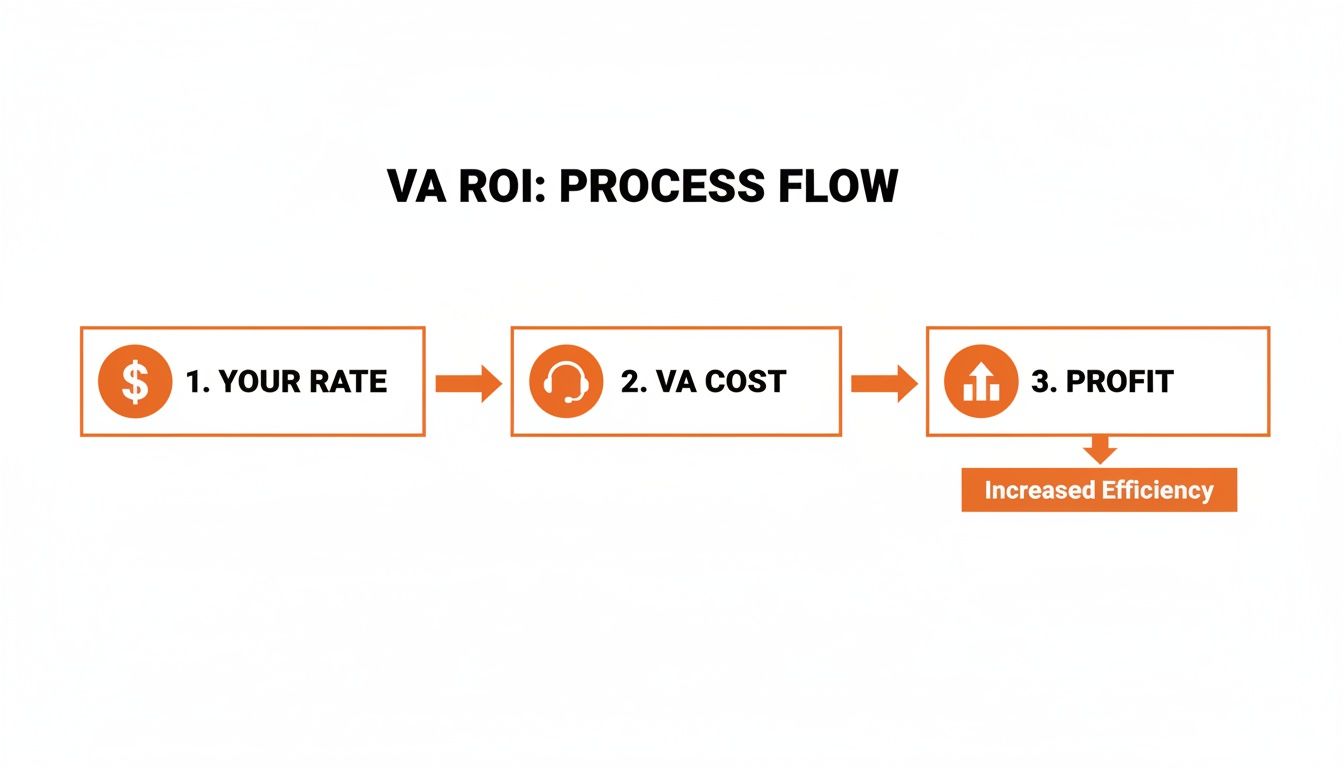
It’s a clear visual of how shifting your time from low-value work to high-value, client-facing activities directly grows your bottom line.
Managing Integrations and Compliance
A modern real estate business runs on a stack of software. Your VA will need to get into your CRM, email marketing platform, and maybe even your transaction management software. It’s critical to make sure they have the right access and basic training for each tool during onboarding.
Many AI assistants make this even easier with direct integrations that can automatically log call notes right into your CRM. If you're curious about how these connections work, our guide on the HubSpot and Zendesk integration offers a great look under the hood.
A Crucial Note on Compliance: Remember, an unlicensed virtual assistant cannot legally do anything that requires a real estate license. Stick to delegating administrative, marketing, and client coordination tasks. Always stay up-to-date with your local and state regulations.
Data security is also non-negotiable. Set up strict rules for handling client information, including using secure file-sharing and encrypted communication channels. A clear non-disclosure agreement (NDA) is also standard practice when working with any outside assistant. It provides peace of mind for you and your clients. By tackling these things upfront, you build a secure and compliant foundation for your growing business.
Putting an AI Voice Assistant to the Test: Real-World Scenarios
It's one thing to talk about what a tool can do, but it's another thing entirely to see it in action. So, let’s move past the theory and look at how an AI voice assistant actually works in the real world of real estate.
Think of these as snapshots of your business—but with the tedious, time-sucking parts running on autopilot. This isn't science fiction; it’s what a smart virtual assistant for real estate, like CallCow, can do for you today.

Scenario 1: The Overnight Lead Tsunami
The Problem: You’ve just launched a new Facebook ad for a fantastic listing, and it takes off. You wake up to 150 new leads flooding your inbox. You know you have to act fast—speed is everything in this game—but calling every single one would eat up your entire day. With every minute that ticks by, those leads get colder.
The AI Solution: Your AI assistant got to work the second each lead hit your system. While you were sleeping, it called all 150 of them, using a natural, human-like voice to ask your key qualifying questions. "Are you already working with an agent?" "Have you been pre-approved for a mortgage?"
The Outcome: You grab your morning coffee and see that the AI has already sifted through the noise. It has booked appointments directly into your calendar with the 20 hottest, most qualified prospects and logged the call notes in your CRM. Your day is now packed with promising conversations, not hours of cold calling.
Scenario 2: The 24/7 Rental Hotline
The Problem: A "For Rent" sign is a beacon for phone calls, and they come in at all hours—late at night, on weekends, and during family dinners. You can’t possibly field every call, which means you’re missing out on good tenants. Each unanswered ring could be the perfect renter moving on to the next property.
The AI Solution: Your AI assistant becomes your tireless leasing agent. It answers every call, 24/7, and provides essential details like the rent price, security deposit, and pet policy. It can even pre-screen callers based on your criteria, like minimum income or credit score requirements.
The Outcome: The best part? Qualified tenants can schedule a viewing right then and there, directly with the AI. Your calendar fills up with vetted applicants, and you don’t have to lift a finger. You get to spend your time actually showing the property to serious people, not just answering the same basic questions all day.
Your phone line transforms from a constant source of interruption into a fully automated lead qualification machine. You get the power of a full-time receptionist for a tiny fraction of the cost.
Scenario 3: Effortless Post-Showing Feedback
The Problem: After a busy open house, following up with every single person who attended is critical. You need to gather feedback, gauge interest, and find your serious buyers. But let's be honest, it’s a grueling task that often gets pushed aside for more urgent things.
The AI Solution: Just a few hours after the open house wraps up, your AI assistant automatically calls every person who signed in. It asks targeted questions you’ve prepared, like, "What was your impression of the kitchen?" or "On a scale of 1 to 10, how likely are you to make an offer?"
The Outcome: The next morning, a clean, transcribed summary of all the feedback is waiting for you. You immediately see who the hot leads are and what people really thought about the property. You gain priceless insights on pricing and presentation, all without making a single dial yourself.
Common Questions About Real Estate Virtual Assistants
Thinking about bringing a virtual assistant into your real estate business? It’s a smart move, but it’s natural to have a few questions pop up. Let's tackle some of the most common ones so you can feel confident you're making the right call.
How Much Does a Real Estate VA Cost?
The cost really depends on what kind of help you’re looking for. A human virtual assistant can run you anywhere from $15 to over $50 per hour, based on their skill level and where they're located. This makes sense for tasks that need a personal touch or a lot of creative problem-solving.
On the other hand, an AI voice assistant like CallCow usually works on a subscription plan. This can be a game-changer for your budget, especially when you need someone to handle a high volume of calls, like qualifying leads 24/7. You get powerful, round-the-clock support without the price tag of a full-time employee.
Can a VA Legally Handle All Real Estate Tasks?
This is a big one, and the answer is a firm no. Your virtual assistant cannot perform any activity that requires a real estate license in your state unless, of course, they are licensed. This means they can't give property advice, negotiate contracts, or host an open house.
Think of your VA as your operational wingman, not your licensed replacement. Their job is to crush the administrative, marketing, and lead follow-up tasks that free you up to focus on the dollar-producing activities only a licensed agent can do. Always double-check your local real estate commission rules to stay compliant.
How Is My Client Data Kept Secure?
Protecting your client's information is paramount. If you're working with a human VA, have them sign a non-disclosure agreement (NDA) from the get-go. Use a secure password manager to grant them access to your systems without ever handing over your actual passwords.
When it comes to AI platforms, dig into their security protocols. Any reputable service will use strong encryption and be built on secure infrastructure to keep your—and your clients'—data locked down tight.
Ready to see how an AI assistant can field your calls and book qualified appointments around the clock? See what CallCow can do for your real estate business and start for free. Learn more at https://callcow.ai.