Virtual Assistant for Real Estate Agents: A Comprehensive Guide
Discover how a virtual assistant for real estate agents can streamline workflows, save time, and grow your business with practical tips and tools.Think of a real estate virtual assistant as your remote "mission control." This person—or increasingly, this AI-powered service—handles the daily grind of administrative, marketing, and operational tasks so you can get back to what you do best: building relationships and closing deals. They are the engine under the hood, managing everything from scheduling and lead qualification to keeping your CRM spotless.
Stop Juggling Calls and Start Closing Deals
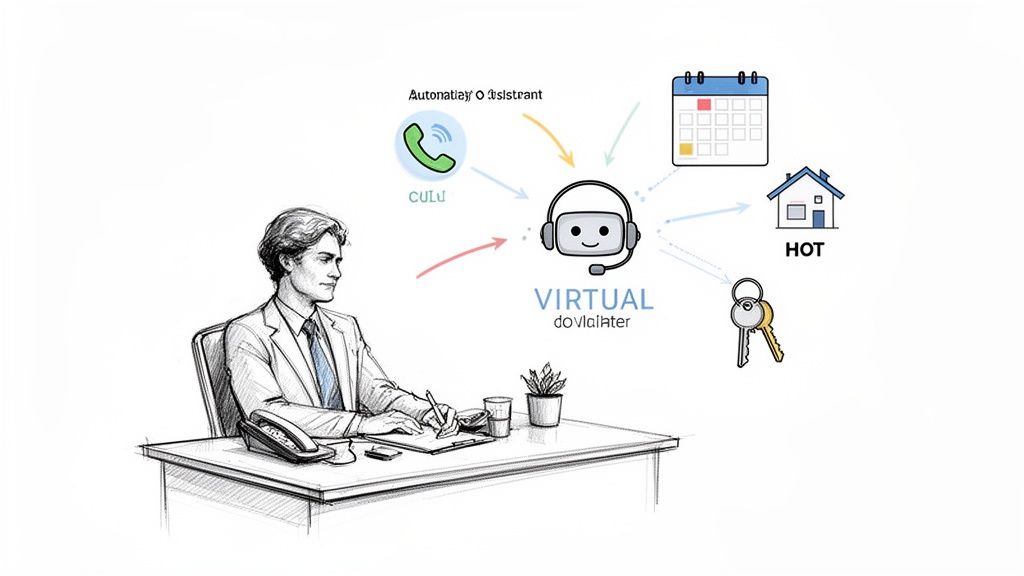
Picture this: You go through an entire day without a single missed call from a potential lead. Showings seem to schedule themselves, and your focus is locked on your clients, not on endless paperwork. This isn't some far-off dream. It's the reality for agents who bring a virtual assistant into their business. They become the operational backbone, taking over the repetitive, time-sucking tasks that drain your energy and pull you away from your clients.
Reclaim Your Most Valuable Asset: Time
At its core, the value of a real estate virtual assistant is incredibly simple: it gives you back your time. Instead of getting buried in logistics, you’re free to pour your energy into the things that actually make you money—negotiations, client meetings, and growing your network.
This isn't just about convenience; it's a strategic business move. In the non-stop world of real estate, agents who use VAs are spending 30-40% less time on administrative work. A perfect example is Keller Williams Realty, which found its agents reclaimed about 30% of their time for face-to-face client activities. The result? A 20% jump in annual sales. You can find even more proof in recent VA industry statistics.
A virtual assistant acts as a force multiplier. A solo agent can suddenly operate with the efficiency of a small team, and a brokerage can scale its operations without the heavy overhead of hiring more in-house staff.
The Modern Real Estate Powerhouse
Today’s VAs are so much more than just admin help; they're genuine strategic partners. This is especially true with the new wave of AI-powered assistants that offer 24/7 support. They can answer calls the second they come in, qualify brand-new leads based on your exact criteria, and drop appointments directly into your calendar—day or night. This means every single opportunity gets captured, even that 11 PM inquiry from a highly motivated buyer.
Here's a quick look at how a day in the life changes when you bring a VA on board.
Before and After a Real Estate Virtual Assistant
| Agent's Daily Reality | Without a Virtual Assistant | With a Virtual Assistant |
|---|---|---|
| Lead Response | Scrambling to answer calls between meetings. Missed calls go to voicemail. | Every call answered instantly, 24/7. Leads are qualified on the spot. |
| Scheduling | Back-and-forth emails and texts to book a single showing. | Appointments booked automatically based on your calendar's availability. |
| Admin Work | Spending hours manually entering contacts and updating the CRM. | CRM is always up-to-date. Data entry is handled automatically. |
| Client Focus | Distracted by constant pings, alerts, and administrative tasks. | Fully present with clients, focused on negotiations and relationship building. |
| Business Growth | Hitting a ceiling on how many clients you can handle at once. | Able to handle a higher volume of leads and transactions without burnout. |
As you can see, the difference isn't just minor—it's a fundamental shift in how you run your business.
Ultimately, bringing a virtual assistant into your world does three crucial things:
- Increases Your Efficiency: Automating the routine stuff smooths out your entire operation.
- Improves Client Service: You can offer instant responses and consistent follow-up, which clients love.
- Boosts Your Scalability: You can finally handle more leads and close more deals without running yourself into the ground.
Core Tasks Your Real Estate VA Can Automate
A real estate virtual assistant’s job is to systematically take over the daily grind, freeing you up to focus on what truly matters: your clients. Think of them as your operational right hand, handling all the predictable, repeatable tasks that eat up your day. This lets you be fully present for the unpredictable, high-value work of closing deals.
Most of what a VA can handle falls into three big buckets.
Mastering Administrative Support
First up are the administrative tasks—the nuts and bolts of any organized real estate business. A great VA acts as your personal command center, bringing a sense of calm to the chaos that comes with being a busy agent.
Imagine actually hitting inbox zero. Your VA can be the one to sift through emails, shoot back replies to common questions, and flag the messages that genuinely need your eyes on them. Your calendar becomes a well-oiled machine, with your VA scheduling showings, client meetings, and even personal appointments, making double-booking a thing of the past.
Beyond that, they dig into the critical data and document work:
- Data Entry: Painstakingly entering every new lead, client note, and property detail into your CRM so nothing gets lost.
- Document Preparation: Whipping up listing presentations, buyer packets, and sales reports so you always look professional.
- MLS Management: Keeping your listings fresh by updating statuses, uploading new photos, and writing descriptions that pop.
Streamlining Lead Management and Client Communication
This is where a VA, especially an AI-powered one, can deliver a massive ROI. Let's be honest, effective lead management is what separates the top producers from everyone else, and a VA ensures you never let a good opportunity die on the vine.
With an AI VA, you essentially get 24/7 call answering. That lead who calls at 10 PM on a Saturday? They don't hit your voicemail. They get a professional, instant response. The VA can then qualify them on the spot, running through your key questions: What's their budget? What's their timeline? Do they have a pre-approval letter? Our guide on chatbot lead generation dives deeper into how this kind of automation helps you capture leads you'd otherwise miss.
The impact here is huge. The average agent wastes over 70% of their day on tasks that don't make them money. AI-powered virtual assistants can deliver a 40%+ increase in qualified lead conversions and over 65% faster response times simply by taking over these duties.
Once a lead is qualified, the VA seamlessly updates your CRM with detailed notes, creates a follow-up task for you, and can even book an initial consultation right into your calendar. That entire process—from a random phone call to a warm, scheduled appointment—happens without you lifting a finger.
Powering Your Marketing Efforts
Consistent marketing is the engine of your business, but it's incredibly time-consuming. A real estate VA can step in as your marketing coordinator, executing your plan day-in and day-out to keep your brand visible and your pipeline full.
This means they can handle scheduling all your social media posts for Instagram and Facebook, creating a steady drumbeat of content that keeps your audience engaged. They can also write compelling property descriptions that tell a story, coordinate with photographers to get the best listing shots, and manage your email campaigns to nurture your network.
Ultimately, they handle the execution, freeing you up to focus on the strategy.
Human or AI? Choosing the Right Assistant for Your Real Estate Business
So, you've decided you need help. That’s a big step. Now you're facing the next big question: do you hire a human virtual assistant or an AI-powered one? Both can be game-changers for your real estate business, but they shine in completely different ways. Figuring out their strengths is the key to making a smart choice.
Think of a human VA as your right-hand person, a true partner in your business. They’re perfect for the tasks that need a human touch—things like creativity, strategic thinking, and genuine empathy. You'd want them handling delicate client conversations, crafting truly personal follow-up emails, or managing a dynamic social media campaign that requires quick, intuitive adjustments.
An AI assistant, on the other hand, is your super-efficient, always-on workhorse. It’s built for one thing: execution at scale. It never needs a coffee break, never gets sick, and can answer a client call at 2 AM with the exact same energy and precision as it does at 2 PM. It’s all about speed, consistency, and round-the-clock availability.
Feature Comparison: Human VA vs. AI VA
To really break it down, let's look at how they stack up side-by-side. The best fit for you truly depends on the specific jobs you need to get off your plate.
| Feature | Human Virtual Assistant | AI Virtual Assistant |
|---|---|---|
| Core Strength | Emotional intelligence, creativity, complex problem-solving. | Speed, consistency, 24/7 availability, data processing. |
| Best For | Building client relationships, negotiations, content creation, strategic planning. | Answering every call, initial lead qualification, appointment scheduling, data entry. |
| Availability | Standard business hours, requires breaks and time off. | 24/7/365—never sleeps, never takes a vacation. |
| Scalability | Limited; hiring and training are required to handle more volume. | Instantly scalable; can handle one call or one thousand simultaneously. |
| Cost Model | Typically $5-$25 per hour; you pay for their time. | Often a flat monthly fee or usage-based; far lower cost per interaction. |
| Human Touch | High. Can show empathy, understand nuance, and build genuine rapport. | Low to moderate. Scripted but can be conversational and effective for specific tasks. |
| Consistency | Can have off days or make occasional human errors. | 100% consistent; follows the script and rules perfectly every single time. |
Ultimately, a human VA excels where nuance and relationship-building are paramount. An AI VA dominates when it comes to repetitive, high-volume tasks that demand speed and accuracy.
This simple decision tree can help you visualize where each type of assistant fits best, from basic admin work to complex marketing efforts.
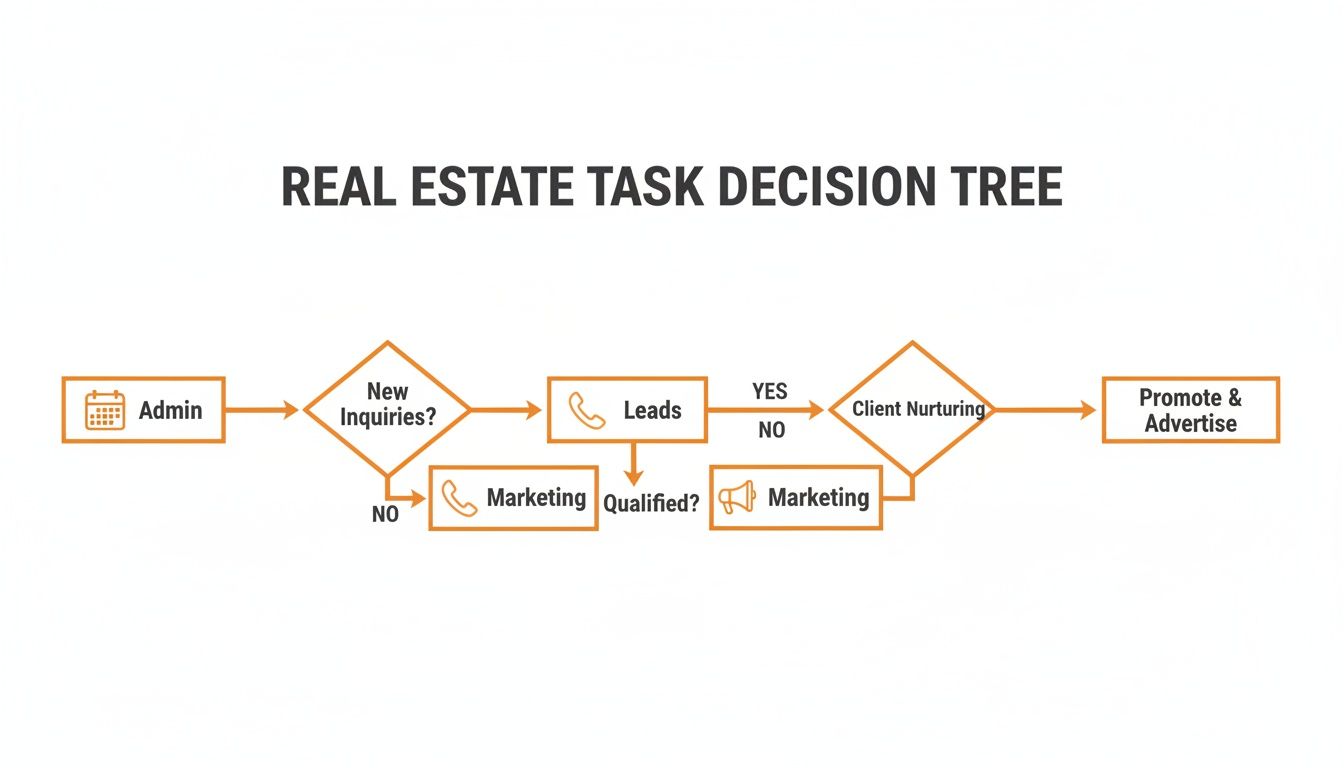
As you can see, the routine stuff like initial lead capture and basic scheduling are perfect for an AI. The more complex tasks, like nurturing a long-term client or crafting a unique marketing angle, are where a human really shines.
The Hybrid Model: Your Win-Win Strategy
Here’s the thing: you don’t have to pick just one. The smartest and most successful agents are building a hybrid team that combines the best of both worlds.
The new powerhouse model works like this: an AI voice agent acts as your frontline, fielding every single call 24/7. It instantly qualifies new leads and books them directly into your calendar. Then, it seamlessly hands off those warm, pre-vetted appointments to you or your human VA for the high-touch, personal follow-up that seals the deal.
This isn't some futuristic idea; it's what's happening right now. By having an AI handle the initial contact, you ensure 25% faster lead response times and can see up to a 20% increase in conversions. Why? Because no lead ever falls through the cracks again.
You get the unmatched efficiency and cost-effectiveness of AI paired with the irreplaceable empathy and strategic thinking of a human. It's a scalable system that delivers both flawless operations and an exceptional client experience.
To see how this powerful combination works in a broader context, take a look at our guide on the virtual receptionist for small business. This approach isn't just for real estate—it's about building a smarter, more responsive business.
Real-World Scenarios and Use Cases
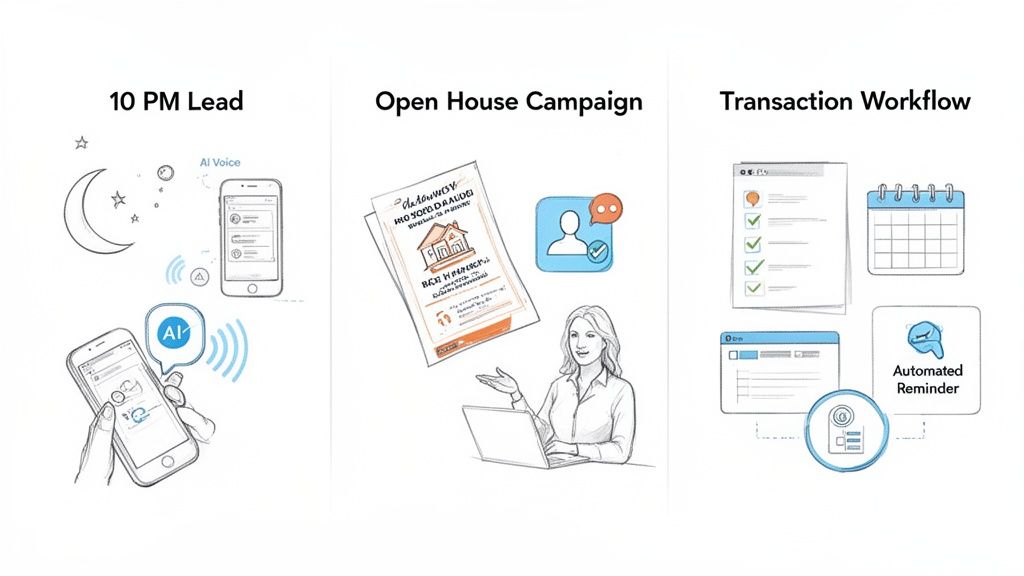
It’s one thing to talk about features and another to see how a virtual assistant for real estate agents can actually transform your day-to-day grind. The real magic happens when you see these tools solve the problems every agent runs into.
Let’s walk through a few common situations to show you exactly how this kind of support translates into more deals closed and a lot less stress. These aren't abstract ideas; they're practical examples of how you can boost your efficiency, make clients happier, and grow your bottom line.
Scenario 1: The 10 PM Lead
Picture this: you're finally done for the day when a highly motivated buyer drives by one of your listings. It's 10 PM. They see your sign, call the number, and get… your voicemail. Just like that, their excitement starts to fade.
Now, imagine that same scenario with an AI voice agent.
- Instant Connection: The AI answers on the first ring with a professional greeting.
- Information Exchange: It can handle basic questions like, "Is it still available?" or "How many bedrooms?" and smoothly collects the caller's contact details.
- Actionable Next Step: The agent then taps into your calendar and offers to book a follow-up call with you first thing in the morning.
You wake up to a warm, qualified lead already on your schedule. You just captured an opportunity that 9 out of 10 agents would have missed, and you did it in your sleep. You can find more practical examples in our breakdown of specific use cases for realtors.
Scenario 2: The Open House Campaign
An open house is a goldmine for leads, but managing all the moving parts is a huge time suck. This is where a human virtual assistant can really shine, taking over the entire marketing and follow-up process with a personal touch.
Your VA can take charge of all the coordination, handling tasks like:
- Marketing Prep: They can schedule a week's worth of social media posts for Facebook and Instagram, design a simple event flyer, and even coordinate with the print shop.
- Day-Of Support: They can manage a digital sign-in link or quickly compile a clean list of attendees from your paper sign-in sheet.
- Post-Event Follow-Up: The next morning, your VA sends a personalized thank-you email to every single person who attended, asking for feedback and offering to set up a private showing.
This completely frees you up to do what you do best: connect with people at the open house. You can focus on building relationships, knowing all the critical prep and follow-up is already handled.
A well-coordinated open house isn't just about selling one property; it's about building a pipeline. By delegating the logistics, you ensure every attendee feels valued and every lead is nurtured.
Scenario 3: The Seamless Transaction Workflow
Finally, let's talk about the chaos between contract and closing. This is where a hybrid approach—blending AI efficiency with human oversight—is a game-changer. Juggling deadlines for inspections, appraisals, and loan contingencies is stressful, and one missed detail can derail the whole deal.
In this workflow, an AI assistant manages the automated reminders. It can send pre-scheduled texts to your client about upcoming deadlines. At the same time, your human VA handles the complex coordination, talking directly with the title company, lender, and the other agent to make sure every piece of paperwork is in on time.
This two-part system is practically foolproof. The AI makes sure no deadline gets missed, while the human VA navigates the personal conversations needed to get the deal across the finish line. Your client feels completely supported and in the loop, which builds the kind of trust that leads to five-star reviews and future referrals.
Getting Started With Your First Virtual Assistant
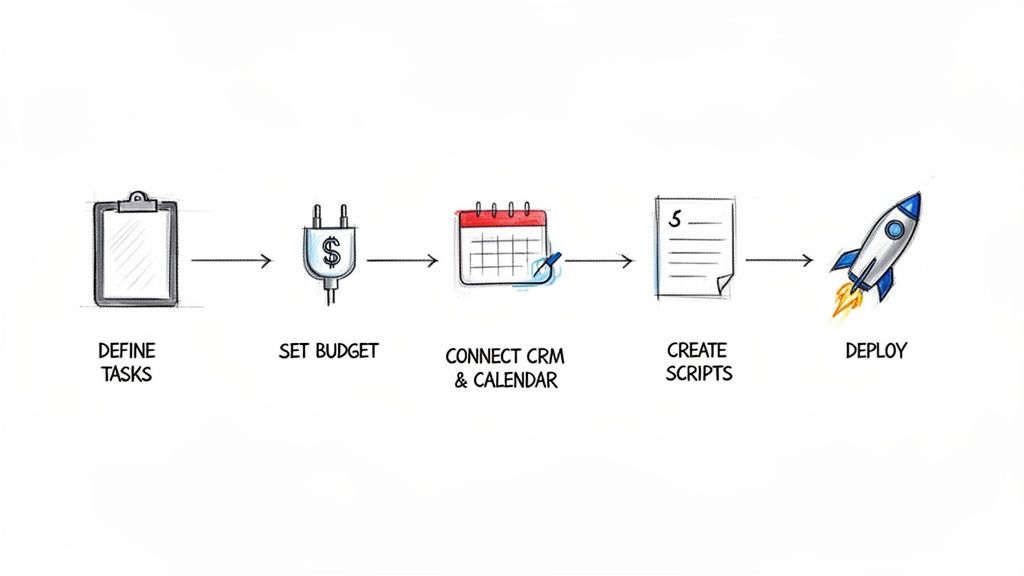
Bringing a virtual assistant into your business can feel like a massive project, but it’s really just a series of small, manageable steps. The trick is to have a clear plan from the get-go instead of just throwing tasks at someone and hoping for the best. A little bit of strategy up front makes for a much smoother rollout and avoids disrupting your day-to-day hustle.
The best place to start? A simple audit of your own time. For one full week, jot down where every hour goes. Be brutally honest about the repetitive, low-impact tasks that pull you away from what actually makes you money—closing deals. Are you stuck doing data entry? Answering the same three questions from new leads over and over? This simple exercise gives you a real, tangible list of things to hand off.
Your Step-by-Step Implementation Plan
Once you know what you need to delegate, you can start laying the groundwork. This is all about defining your goals, figuring out a budget, and getting your current systems ready for a new team member, whether they’re human or AI. A little prep work here saves you from major headaches down the road.
Here’s a simple plan to follow:
- Pinpoint Your Mission-Critical Tasks: Look at your time audit and pick the top 2-3 tasks that create the most drag. For most agents I talk to, this almost always boils down to lead qualification and appointment scheduling.
- Set a Realistic Budget: A human VA might run you $8-$25 per hour. On the other hand, AI voice agents like CallCow often have free plans to get you started and super affordable monthly options. Figure out what you're willing to invest to get that time back.
- Choose the Right Kind of Assistant: If your phone ringing off the hook at all hours is the biggest problem, an AI assistant is a no-brainer for 24/7 coverage. But if you need help with creative marketing campaigns or managing complex transaction paperwork, a skilled human VA is definitely the way to go.
The goal isn't to replace yourself overnight. It's to strategically offload the tasks that drain your energy so you can focus on the high-value work only you can do, like negotiating offers and building strong client relationships.
The Nuts and Bolts of Setup and Onboarding
With your plan locked in, it’s time for the technical setup. This is where you connect your new assistant to the tools you already use every day, making sure they can actually do their job inside your workflow. For any virtual assistant for real estate agents, this means giving them the right access and crystal-clear instructions.
Here’s a quick checklist to make the integration painless:
- Connect Your Tools: Give them limited, secure access to your CRM and calendar. Most modern VA platforms have direct, safe integrations that make this a breeze.
- Create Simple Scripts: Whether it’s an AI agent or a human VA, write down the answers to common questions and outline a few basic call scripts. This is key to making sure your brand’s voice stays consistent.
- Set Up a Call Flow: With an AI agent, you can map out a custom call flow in just a few minutes. This tells the AI exactly what questions to ask and what to do next—like booking a showing on your calendar or automatically sending a follow-up text.
Finally, remember to start small. Have your VA handle just one main task at first. Watch how it goes, make tweaks, and then slowly add more to their plate as you both get into a groove. This slow and steady approach is the secret to building a successful, long-term partnership.
Measuring the ROI of Your Virtual Assistant
Let's be clear: a virtual assistant is an investment in your business, not just another line item on your expense report. But like any good investment, you need to see the return. When we talk about the Return on Investment (ROI) for a virtual assistant for real estate agents, we're looking at more than just the money you save. It's about buying back your most valuable, non-renewable resource: time.
The easiest way to start is by looking at the hard numbers—the metrics you can actually track to see a direct impact.
Tracking the Tangible Returns
First things first, what's your time worth? Seriously, put a dollar amount on it. If you value your time at $100 per hour, every single hour your VA spends on admin tasks is a $100 gain for you. That’s an hour you can now spend on activities that actually generate income.
If your VA takes over 10 hours of administrative work a week, that's a $1,000 return in productive value right there.
From there, you can look at the key performance indicators that directly pad your bank account:
- More Appointments on the Books: How many additional showings or client meetings are you getting each month?
- Quicker Lead Response: Are you getting back to new leads in minutes instead of hours? This is a huge factor in winning business.
- Better Lead Conversion: What percentage of those online inquiries are actually becoming clients you work with?
We've seen agents who automate their initial lead contact and follow-up see a 20-30% jump in qualified appointments in just the first few months. Why? Because they're finally catching all those leads that used to slip through the cracks.
The Equally Important Qualitative Gains
While the numbers are great, some of the most significant benefits of a VA aren't so easy to stick on a spreadsheet. These qualitative gains are about improving your day-to-day work life and the experience you give your clients, which ultimately fuels your long-term success.
Think about your stress level. When you offload the constant back-and-forth of scheduling and answering basic inquiries, you free up incredible amounts of mental energy. This means you can be fully present and sharp during a tough negotiation or a crucial client meeting.
Plus, faster, more consistent communication makes for happier clients. Happy clients leave glowing reviews and, more importantly, send you referrals—the lifeblood of any real estate business.
This is also how you start to scale. With a VA managing the operational details, you can finally take on more listings or launch that new marketing campaign you've been thinking about. It's not about working less; it's about building the capacity to grow your business without burning yourself out.
Common Questions About Real Estate Virtual Assistants
Thinking about bringing a virtual assistant into your real estate business? It’s a smart move, but it’s natural to have a few questions before you jump in. Let’s clear up some of the most common ones.
What’s This Going to Cost Me?
The price tag on a real estate VA really depends on who you hire and where they’re located. A human assistant based overseas might cost you anywhere from $5 to $15 an hour. If you're looking for someone US-based, that rate typically climbs to $25 to $50 or more per hour, reflecting their local market and experience.
AI voice agents, on the other hand, play a completely different ballgame. Many services have free plans to get you started, with full-featured subscriptions often landing under $50 a month. For 24/7 call handling, that’s an incredible value.
Will They "Get" the Real Estate Business?
Yes, and this is a crucial point. Any good VA service that specializes in real estate makes sure their assistants know the lingo and the process. They’re not starting from scratch.
For an AI assistant, it’s all about the setup. You train it with your specific scripts, answers to common questions, and industry keywords. It learns your business and your market, so it can represent you accurately on every single call.
Security is non-negotiable when choosing a virtual assistant. Always prioritize partners with clear data privacy policies, confidentiality agreements, and secure, encrypted systems.
A good pro-tip is to give your VA role-based access to your tools instead of just handing over the master keys. This keeps sensitive client data locked down and gives you complete peace of mind.
Ready to see how an AI voice agent can capture every lead and book appointments for you 24/7? CallCow provides a human-sounding assistant that integrates directly with your calendar and CRM. Explore how CallCow works and start your free trial today.