
A Guide to Using a Virtual Receptionist for Lawyers
Discover how a virtual receptionist for lawyers can transform your firm by improving client intake, saving time, and increasing revenue. Get started today.Ever wonder what a virtual receptionist really is, especially for a law firm? It's not just an answering service. It's a specialized team that acts as the professional front door for your practice, handling your inbound calls, screening new leads, and getting qualified consultations booked on your calendar.
The goal is simple: make sure you never miss a potential client's call while freeing up your team to focus on what they do best—practicing law.
The Hidden Costs of a Ringing Phone in Your Law Firm
In a busy law office, every ringing phone is a dilemma. Do you interrupt a deposition or a client meeting to grab it? That can feel unprofessional to the person right in front of you. Or, do you let it ring through to voicemail? That’s a huge risk. A potential client with an urgent problem is probably just going to hang up and call the next lawyer on their list.
This isn't a small annoyance. It's a constant drain on your firm's revenue and focus.

Let's talk numbers. Studies have found that lawyers, on average, bill for just 2.9 hours per day. The rest of that time gets eaten up by essential but non-billable work. Answering the phone, trying to figure out if a caller is a good fit, and scheduling appointments are some of the biggest culprits.
The Problem with Inconsistent Intake
When everyone on your team pitches in to answer calls, you create an unpredictable experience for potential clients. A paralegal might ask different questions than an associate, which leads to a messy and inconsistent intake process.
This kind of fragmentation causes real problems:
- Lost Leads: Callers can be put off by a rushed or unprofessional greeting.
- Wasted Time: Crucial details get missed, meaning you have to call people back just to get the basic information you need.
- Poor First Impressions: A chaotic phone experience makes your firm seem disorganized, which kills trust from the very first interaction.
This is the exact problem a virtual receptionist for lawyers is built to solve. It ends the constant tug-of-war between doing billable work and handling administrative tasks.
Think of it less as an answering service and more as a strategic part of your firm. It's a system designed to protect your most valuable asset—your time—while making sure every single business opportunity is captured professionally.
When you have a dedicated service in place, that ringing phone stops being a disruption and starts becoming a reliable engine for growth. It works around the clock, ensuring every caller gets a prompt, professional, and genuinely helpful response. Inquiries get turned into qualified consultations that appear right on your calendar, all without you ever having to hit pause on your important legal work.
What Exactly Is a Virtual Receptionist for a Law Firm?
When you hear “virtual receptionist,” you might just picture someone answering calls from a remote location. But for today’s law firms, that’s only a tiny piece of the puzzle. A better way to think about it is as a digital front desk specialist—a purpose-built system designed specifically for the legal field that manages your most important first impressions, 24/7.
This isn't just about saying hello. This specialist can qualify a brand-new lead based on your firm’s specific needs, like their legal issue or location. If they're a good fit, it can book them for a consultation right on your calendar, often connecting directly with the practice management software you already use.
This shift is happening for a reason: law firms need to be more efficient. The market for virtual receptionists has exploded to $3.85 billion and is expected to hit nearly $9 billion by 2033. Even more revealing is how quickly law firms are jumping on board. One report showed AI use for front-office tasks skyrocketed from just 19% to 79% in a single year. You can dive deeper into the rise of AI receptionists on ResonateApp.com.
Human-Powered vs. AI-Powered: What’s the Difference?
It’s really important to know the two main flavors of virtual receptionists so you can pick the right one for your practice. They both handle communications, but in very different ways.
Human-Powered Services: Think of these as the traditional answering services. Real people answer your calls, which is great for providing a warm, personal touch. They’re good at following basic scripts, taking messages, and simple scheduling. The downside? Their capabilities are often limited, and the costs can add up fast as your call volume grows.
AI-Powered Agents: This is where things get interesting. Modern AI agents, like the one we've built at CallCow, use conversational AI to have surprisingly natural and intelligent chats with callers. These systems aren't just answering the phone; they're running complex workflows that you design.
An AI virtual receptionist for a law firm is less of a call-answerer and more of an automated intake coordinator. It can figure out if a caller’s problem fits your practice areas, collect their key details, and get an appointment booked on the spot—all without a single person on your team lifting a finger.
This Is More Than Just an Answering Service
The real value of a modern virtual receptionist is how it becomes a core part of your firm's day-to-day operations. It's not about catching missed calls. It's about building a smooth, professional, and efficient path for new clients, starting the moment they decide to call you.
Consider a classic time-waster for any law firm. A potential client calls about a personal injury case, but you only practice family law. A traditional receptionist would jot down a message, and an attorney would have to spend their valuable time calling back just to explain it's not a fit.
An AI-powered agent flips that script entirely. You can program it with your exact intake criteria. When the call comes in, the AI asks a few conversational questions to see if it’s the right kind of case. If it’s not a match, it can politely let the caller know and even offer a referral if you’ve set one up. This simple process saves time for everyone and makes sure your lawyers are only spending time on calls that can actually turn into clients.
How a Virtual Receptionist Benefits Your Practice
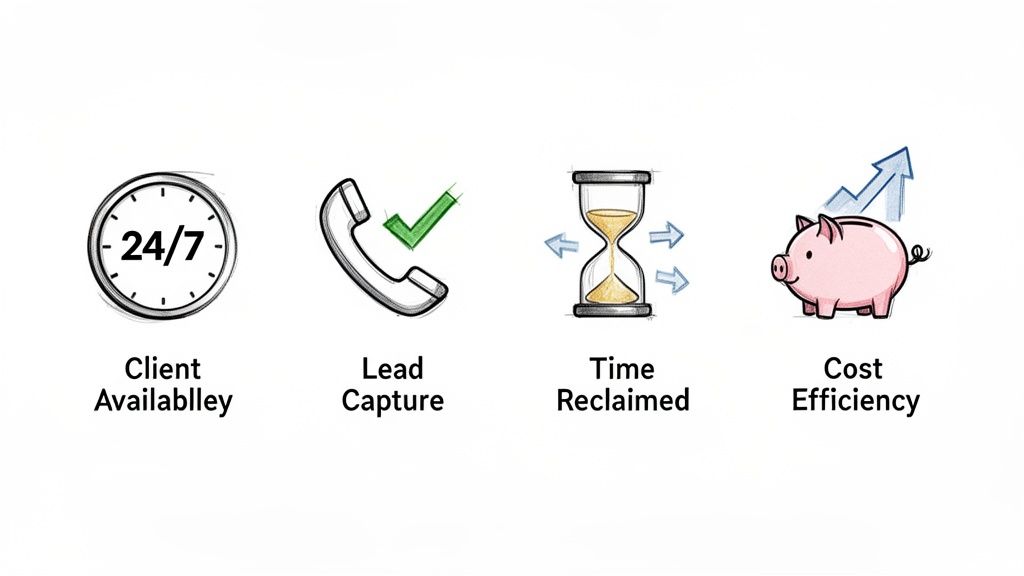
Bringing a virtual receptionist on board isn't just about managing calls—it’s a strategic move that delivers real, measurable improvements across your entire law practice. Think of it as a force multiplier for your firm, strengthening everything from client relationships to your bottom line. The benefits are tangible and immediate, falling into four key areas.
Elevate Your Client Experience
In the legal world, first impressions are everything. When a potential client is stressed and looking for help, the last thing they want is a phone that rings endlessly or a cold, impersonal voicemail. A virtual receptionist ensures every single caller gets a prompt, professional, and empathetic response, any time of day.
That 24/7 availability shows your firm is reliable and accessible, building trust from the very first interaction. Whether someone calls at 2 PM on a Tuesday or 2 AM on a Sunday, your firm's front door is always open and ready to assist.
Capture Every Single Lead
Every missed call is a missed opportunity. It’s a potential client who is now likely dialing your competitor. A virtual receptionist for lawyers is your firm's safety net, making sure no new business slips through the cracks. It answers every call, follows your specific intake script, and qualifies leads right then and there.
By taking voicemail out of the equation for new clients, you can drastically increase your conversion rates. The system can even book qualified callers for consultations directly on your calendar, turning a simple inquiry into a scheduled appointment in one smooth conversation.
Key Insight: Firms using these services have seen their response times plummet from hours to under 60 seconds. That’s a service speed improvement of roughly 90% over manual follow-ups. In today's market, that speed is what wins clients.
Reclaim Your Most Valuable Asset: Time
Time is the one resource attorneys can never get back. Administrative chores like answering phones, screening callers, and scheduling appointments constantly pull you away from high-value, billable work. A virtual receptionist takes these repetitive tasks completely off your plate.
Imagine being able to focus entirely on case strategy and client work, knowing your phones are handled perfectly. This isn't a minor tweak; it’s a fundamental shift. In fact, a 2024 summary found that 23% of law firms using virtual receptionists saved over 10 hours per month. You can explore more on how these services are built for legal professionals with our virtual receptionist solutions for lawyers.
Achieve Significant Cost Efficiency
Finally, let’s talk numbers. The cost of a full-time, in-house receptionist goes far beyond salary. You have to factor in benefits, payroll taxes, paid time off, and the overhead for office space and equipment. These expenses can easily double the cost of an employee.
A virtual receptionist swaps all those variable costs for a predictable, low monthly fee. It’s a much smarter financial model, especially for solo practitioners and small to mid-sized firms. You get all the perks of a dedicated front-desk professional without the financial weight.
Let's break down the comparison.
Traditional Receptionist vs. Virtual Receptionist
This table shows a side-by-side look at how a traditional in-house receptionist stacks up against a modern AI-powered virtual receptionist.
| Feature | Traditional In-House Receptionist | AI Virtual Receptionist |
|---|---|---|
| Availability | Typically 8 hours/day, 5 days/week | 24/7/365, including nights & holidays |
| Monthly Cost | $3,500 - $5,000+ (salary, benefits, taxes) | $100 - $500 (predictable subscription) |
| Lead Capture | Limited to business hours; missed calls go to voicemail | Captures every call, qualifies leads instantly |
| Scalability | Fixed; hiring another person is slow and costly | Instantly scalable; handles unlimited simultaneous calls |
| Efficiency | Prone to human error, multitasking limitations | Consistent, error-free, follows scripts perfectly |
| Overhead | Requires office space, computer, phone, etc. | Zero overhead; fully remote solution |
The financial and operational advantages are clear. A virtual receptionist gives your firm the professional front desk it needs while freeing up capital and time that you can reinvest into growing your practice.
Choosing the Right Features for Your Law Firm
Picking a virtual receptionist for your law firm isn't just about hiring someone to answer the phone. It's about finding a strategic partner with the right tools to handle the unique rhythm and demands of a legal practice. The right features can turn a simple answering service into a well-oiled machine for client intake and scheduling.
Let's be clear: not all virtual receptionist services are built the same. Focusing on a handful of key capabilities is what separates a smart investment from a monthly expense. The real goal is to find a system that not only catches every call but weaves itself so perfectly into your daily workflow that you’ll wonder how you ever managed without it.
Core Features Every Law Firm Needs
Think of these as the absolute must-haves. If a service can't deliver on these basics, it’s probably not equipped to provide the level of professionalism and efficiency your firm needs. These are the foundational pillars of a great setup.
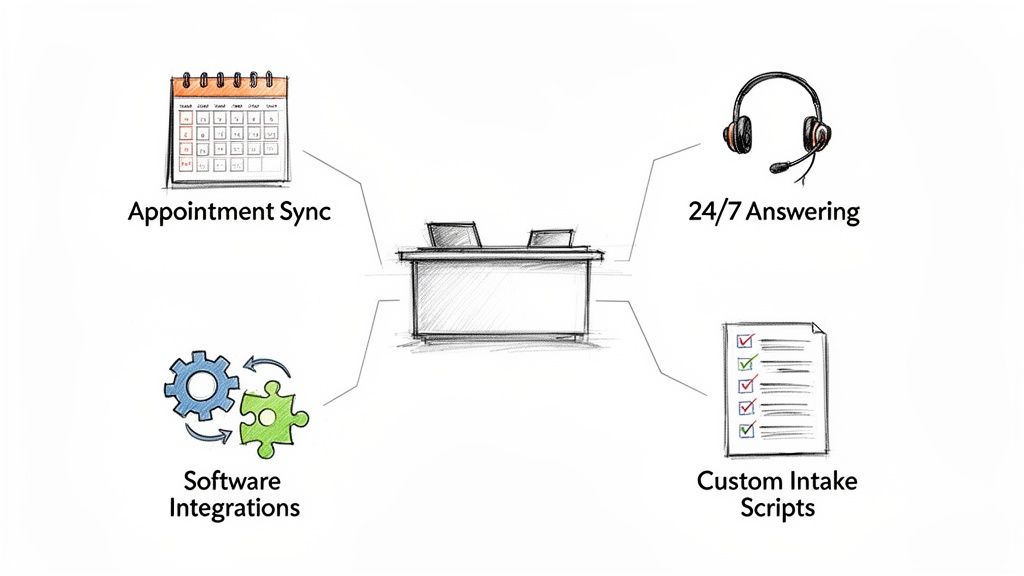
24/7 Call Answering: Legal problems don’t operate on a 9-to-5 clock. When a potential client has an urgent issue, they need a professional, calming voice on the other end of the line—whether it's high noon or the middle of the night. This feature guarantees you never lose a potential case just because of timing.
Intelligent Call Routing: Your receptionist needs to be smart enough to act as a gatekeeper and a director. It should instantly recognize an existing client and patch them through to the right paralegal, or know to escalate an urgent call from a new client straight to your cell based on certain keywords or who is calling.
Appointment Scheduling: This goes way beyond just penciling someone in. A truly effective service will sync directly with the calendars your firm already uses, like Google Calendar or Outlook. This completely eliminates the risk of double-booking and makes scheduling a hands-off process for you and your staff.
For a closer look at what separates the good from the great, check out our complete guide to selecting a law firm phone answering service to learn more.
The Power of Seamless Integrations
A virtual receptionist shouldn't be an island. Its true value is unleashed when it can talk to the other software you rely on every single day. This is what transforms a basic answering service into a powerful workflow automation tool.
The single most critical feature for any modern law firm is integration with legal practice management software. When your virtual receptionist can instantly push new client details into systems like Clio or MyCase, you kill manual data entry, slash the risk of human error, and ensure every single lead is tracked from the very first phone call.
This kind of automation means a new client's contact info and intake notes are already logged in your case management system moments after they hang up. You get a single, reliable record for all client data, which helps organize your entire intake process and saves hours of administrative busywork every week.
Advanced Capabilities That Set Services Apart
Once you've got the essentials covered, a few advanced features can give you a serious competitive advantage. These capabilities are what take the client experience from good to great and add a layer of intelligence to your intake process that makes your firm look incredibly responsive and on the ball.
Customizable Intake Scripts: Every area of law has its own unique needs. The questions you need to ask a potential family law client are completely different from those for a criminal defense case. The ability to create custom intake scripts for each case type ensures your virtual receptionist is always asking the right questions, helping to qualify leads before they ever take up an attorney's valuable time.
Natural Language Processing (NLP): Modern AI receptionists use NLP to have conversations that actually sound human. This technology lets the system understand the nuances of a conversation, adapt to questions you didn't plan for, and create a much better first impression than a clunky, robotic phone tree. It makes callers feel like they're being heard, which is the first step in building trust.
By carefully weighing these core, integration, and advanced features, you can confidently choose a virtual receptionist that will do more than just answer your calls—it will actively help grow your practice.
Maintaining Client Confidentiality and Compliance
For any lawyer, protecting attorney-client privilege is everything. It’s the bedrock of our profession. So, the idea of letting an outside service handle client calls can feel a bit unsettling at first. But a high-quality virtual receptionist for lawyers isn't designed to risk your ethical obligations—it's built to reinforce them.
It all starts with serious data security. Think of it this way: you wouldn't leave sensitive client files out on your desk overnight. The same principle applies here. All call data, notes, and transcripts must be locked down with end-to-end encryption, both when they're being transmitted and when they're stored. This creates a digital fortress around your client's information.
Upholding Attorney-Client Privilege
So, how do you make sure a non-lawyer on the other end of the line doesn't accidentally cross into giving legal advice? The answer is simple: carefully designed call scripts. This is your most important tool. A virtual receptionist is never an attorney, and a good service makes sure they never act like one.
You are in complete control of the conversation. Scripts act as an ethical guardrail, ensuring the receptionist only asks the specific, non-privileged questions you've approved for intake—like basic contact details and a general reason for the call.
This scripted approach actually turns your intake process into a compliance asset. It standardizes how every new call is handled, making sure you get the exact information you need without straying into sensitive territory. Honestly, it's often more consistent and reliable than a manual process where conversations can easily wander off-script.
Secure Data Handling and Trust
Beyond the scripts and encryption, a trustworthy provider will be obsessed with secure data handling. This means having strict rules about who can access your data, undergoing regular security audits, and demonstrating a clear commitment to privacy that meets the legal industry's high standards. You absolutely need to know how your provider is managing and protecting the data they handle for you.
Here are the non-negotiable security pillars to look for:
- Data Encryption: This scrambles all communications and stored data, making them unreadable to anyone without authorization. It’s your first line of defense.
- Secure Access Protocols: This ensures only you and your authorized staff can see sensitive client notes and call details. No one else should have access.
- Compliance with Standards: The service must follow recognized data protection regulations. For a transparent example of what this looks like, you can see CallCow’s commitment to data protection in our privacy policy.
When you choose a virtual receptionist service that makes security a top priority, you aren't outsourcing your ethical duties. You're simply using smart technology to strengthen them. It gives you the peace of mind to focus on your clients, knowing every lead is captured professionally and every confidence is kept.
Calculating the ROI for Your Law Firm
When you're looking at any new tool for your practice, it's not just about cool features—it's about the bottom line. Will this actually make my firm more money? A virtual receptionist for lawyers isn't another line item in your expense column; it’s a revenue generator.
Let's break down the math. It's simpler than you might think and really comes down to three key areas: the time you get back, the new clients you capture, and the leads you actually convert. Once you see the numbers, the business case becomes incredibly clear.
The Value of Reclaimed Billable Hours
Let's start with the most obvious win: your time. Every single call you or your paralegal takes to schedule an appointment or answer a basic question is time you're not spending on billable work. A virtual receptionist acts as a gatekeeper, shielding you from those constant interruptions.
Think about it with this quick calculation:
- Estimate Your Admin Time: How many hours a week does your team spend on phone-related tasks? Let's be conservative and say it’s five hours.
- Calculate the Weekly Value: Now, multiply that by your average hourly rate. If you bill at $350/hour, that's $1,750 per week in potential billable time you've just unlocked.
- See the Annual Impact: That comes out to over $91,000 per year in reclaimed time that can go directly into client work and growing your practice.
The Cost of a Single Missed Call
Now for the flip side: what about the opportunities you’re missing? When a potential new client calls your firm and hits voicemail, they don't leave a message and wait patiently. They hang up and call the next lawyer on the Google results page.
Every one of those missed calls is a potential case walking out the door.
If the average lifetime value of a client is $5,000, losing just one potential client a month costs your firm $60,000 a year. A virtual receptionist plugs that leak by ensuring a professional, human voice answers every single time.
This process flow shows how a virtual receptionist for lawyers maintains compliance while securely filtering calls with ethical scripts.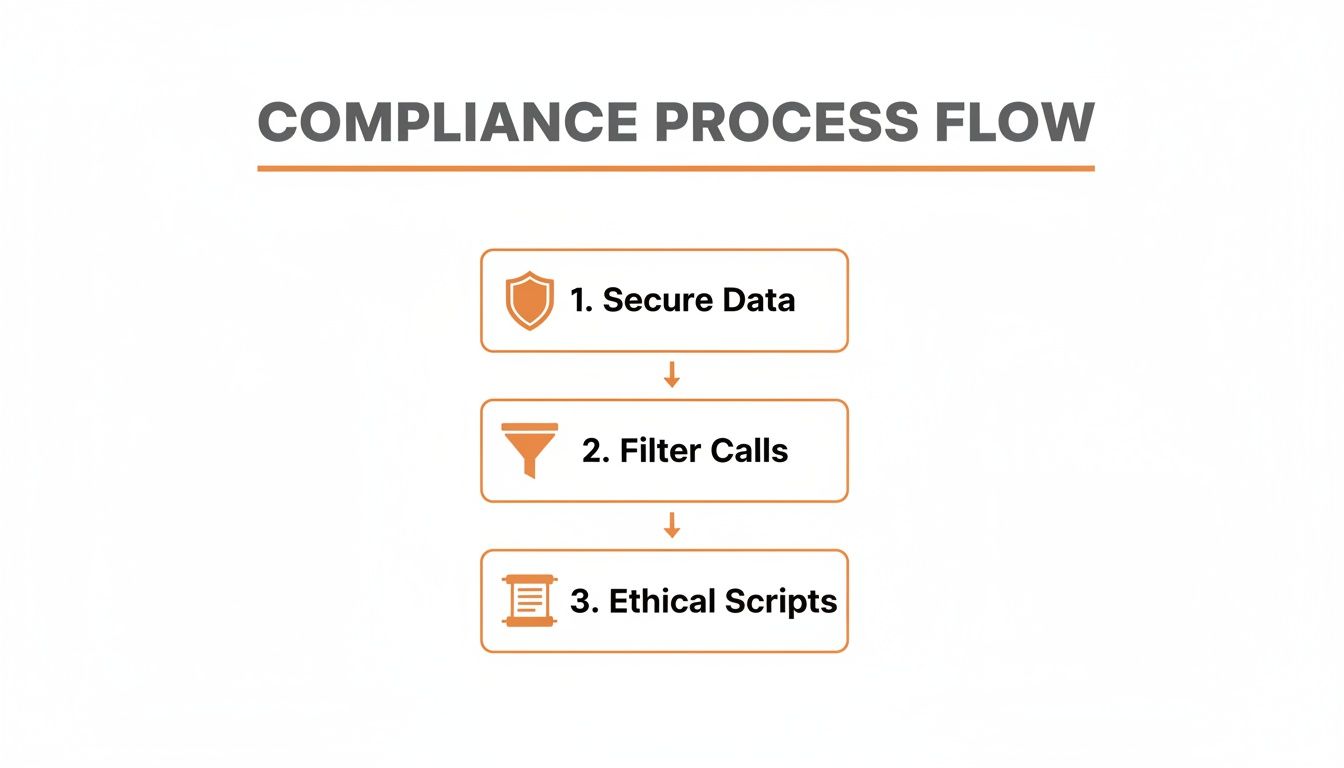
The visualization highlights a structured approach, ensuring every interaction adheres to strict legal and ethical standards from start to finish.
Increased Revenue from Better Lead Conversion
Here’s where the real financial magic happens. A great virtual receptionist service does more than just answer the phone; it actively qualifies your leads and gets qualified consultations on your calendar. By responding instantly and following a proven script, you convert far more callers into actual clients.
A TeleWizard analysis showed this perfectly. By improving its answer rate and standardizing its intake process, one firm boosted its scheduled consultations from 37 to 66 per month. Assuming a 40% close rate and a $2,500 average case value, that simple change led to an extra $30,000 in revenue per month—or $360,000 annually.
When you add it all up—reclaimed billable hours, captured leads that would have been lost, and a higher conversion rate—the ROI isn't just positive, it's undeniable. The service often pays for itself many times over in the first few months, making it one of the smartest investments a modern law firm can make.
Frequently Asked Questions
Thinking about bringing a virtual receptionist on board for your law firm? It’s a big decision, and you probably have a few questions. Let's walk through some of the most common ones we hear from lawyers just like you.
Can a Virtual Receptionist Handle Complex Legal Intake?
In short, yes—but its role is very specific. A properly set up virtual receptionist is a master of that crucial first step: the initial information gathering. It follows the exact script you create to get the essential, non-privileged details—things like contact information and a brief overview of the caller's issue.
Its main job is to see if a new caller is a good fit for your firm based on your criteria and then get that initial consultation on the calendar. It’s not designed to answer complex legal questions or give advice, which keeps it from ever stepping over ethical lines. Think of it as the perfect gatekeeper, making sure every potential client is captured and vetted, freeing up your team for the actual legal work.
Will It Sound Like My Clients Are Talking to a Robot?
This is a huge concern for most attorneys, and thankfully, the technology has come a long way. Modern AI voice systems are incredibly sophisticated. They use advanced natural language processing to create a conversational flow that feels smooth, professional, and honestly, a lot like talking to a real person.
While callers will know it's an automated system, the experience is worlds away from a clunky phone tree or a generic voicemail box. It ensures that first impression is a good one, showing your firm is responsive and on the ball.
The Point: You're not trying to fool anyone. The goal is to give callers an immediate, intelligent, and helpful response instead of sending them to voicemail. It shows you value their time from the very first ring.
How Difficult Is the Setup Process?
The best platforms are designed with busy lawyers in mind, so getting started is surprisingly straightforward. You can usually jump in and customize your call flows and intake scripts using templates, getting the basics up and running in just a few minutes.
Connecting it to your other tools is also pretty simple:
- Calendars: Hooking up Google Calendar or Outlook is typically a one-click affair.
- Legal Software: Many systems have built-in connections to popular practice management software.
- Support: Good providers offer real, hands-on help during onboarding to make sure everything goes off without a hitch.
How Are Urgent Calls or Existing Clients Handled?
This is where customization is key. You can build rules directly into your call workflows to handle these exact situations. For instance, the system can recognize phone numbers from your existing client list and automatically route them to the right attorney or paralegal.
For urgent matters, you can program the system to listen for trigger words like "deadline" or "emergency." If a caller says one of these words, the system can immediately transfer the call to a designated cell phone or fire off an urgent notification to your team. This ensures the truly critical calls always cut through the noise and get immediate attention.
Ready to see how an AI-powered virtual receptionist can change the game for your intake process and give you back more billable hours? CallCow provides a human-sounding, 24/7 solution that works perfectly with the tools you already use. Check out our features and see for yourself.