HIPAA compliant phone services: the buyer's guide
Learn what HIPAA phone answering services need to handle, what a BAA does, and how to evaluate providers for your practice.HIPAA compliant phone services: the buyer's guide
A HIPAA compliant phone answering service handles patient calls while meeting the privacy and security requirements that apply when protected health information is involved. At a minimum, you should expect a Business Associate Agreement (BAA), clear PHI handling rules, and documented safeguards around access and storage.
If you are evaluating CallCow alongside HIPAA-focused vendors, the key distinction is simple: CallCow is for the non-PHI portion of call volume, not the PHI portion. It can help with general inquiries, scheduling flows, and routing, but any call that involves patient health information still needs a provider that signs a BAA and is set up to handle PHI.
That hybrid setup matters because some healthcare practices want to separate general administrative calls from calls that are likely to involve PHI. Office hours, basic scheduling, and general routing may fit a non-PHI workflow. Symptom discussions, refill requests, test results, and treatment questions do not.
Table of contents
- What is a HIPAA-compliant phone answering service?
- Why HIPAA compliance matters for phone services
- What HIPAA compliance actually requires
- HIPAA-compliant answering service features
- How much does a HIPAA-compliant answering service cost?
- HIPAA-compliant answering services compared
- How to choose a HIPAA-compliant answering service
- AI and HIPAA: the current landscape
- Which healthcare businesses need HIPAA-compliant answering?
- Frequently asked questions
What is a HIPAA-compliant phone answering service?
A HIPAA-compliant phone answering service is a third-party call center or answering platform that handles calls for healthcare providers while meeting the legal requirements of HIPAA. The service acts as a "business associate" under HIPAA law, which means it must protect any protected health information (PHI) it encounters during calls.
PHI includes patient names, dates of birth, medical conditions, appointment details tied to a diagnosis, prescription information, and insurance details. If an answering service takes a message that says "John Smith needs a refill on his blood pressure medication," that message contains PHI and the service handling it must be HIPAA compliant.
The distinction matters because not every phone call to a medical practice involves PHI. A caller asking about office hours, location, or whether the practice accepts new patients is not discussing PHI. A caller mentioning symptoms, test results, or medication refills is. The practical problem is that conversations can move from administrative to clinical quickly, which is why conservative buyers treat patient-facing workflows carefully from the start.
There are two types of HIPAA-compliant phone services. Traditional human answering services employ trained agents who follow PHI protocols, work from secure environments, and operate under a signed BAA. AI-based phone services are emerging, but as of 2026, very few have completed the compliance work required to handle PHI legally.
For buyers comparing traditional services with AI tools, this is where CallCow fits. CallCow does not sign a BAA and should not be used for PHI-handling calls. Its practical role is earlier in the funnel: answering general questions, collecting structured intake data for non-PHI use cases, booking appointments, routing callers, and handing off when a conversation needs a HIPAA-compliant workflow.
Why HIPAA compliance matters for phone services
HIPAA violations carry real financial and operational risk. Enforcement actions, breach notifications, remediation work, and reputational damage all get expensive quickly, especially when patient trust is involved.
This is also why the hybrid approach needs clear boundaries. Using a lower-cost AI tool for non-PHI calls can be sensible. Using that same tool once a caller starts sharing symptoms, medications, diagnoses, or other PHI is where the risk begins. The buyer's job is not to find one magical system for every call. It is to match each call type to the right level of compliance.
But the penalties are not the main risk. A data breach involving patient information damages your reputation, erodes patient trust, and can trigger mandatory notification and remediation obligations.
The covered entity does not outsource the risk just because it hired a vendor. If the answering service mishandles PHI, the healthcare provider can still face serious consequences for choosing or supervising that vendor poorly.
The legal framework is straightforward. Under the HIPAA Privacy Rule, covered entities (doctors, hospitals, clinics, pharmacies, health plans) cannot share PHI with third parties unless those third parties sign a Business Associate Agreement and meet specific security requirements. An answering service that takes messages containing patient information is a business associate. No BAA, no legal PHI handling.
What HIPAA compliance actually requires
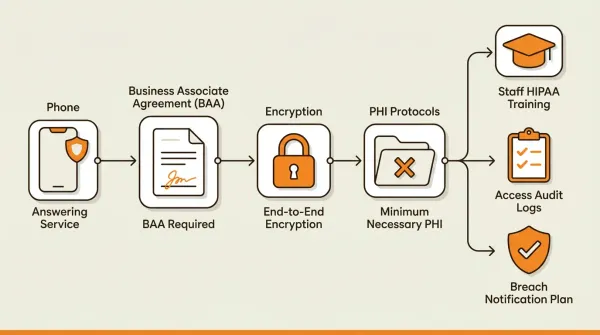
Most articles about HIPAA-compliant answering services say "look for encryption and a BAA" and stop there. That is not enough. Compliance actually means several concrete things for a phone service.
The Business Associate Agreement (BAA)
A BAA is a legal contract between a healthcare provider (the covered entity) and the answering service (the business associate). It establishes that both parties are responsible for protecting PHI and outlines what happens if a breach occurs. Without a signed BAA, a phone service cannot legally handle PHI, period.
The BAA should specify: what types of PHI the service will handle, how PHI is stored and transmitted, the service's breach notification obligations, the duration of the agreement, and termination conditions. If a service claims to be HIPAA compliant but will not sign a BAA, they are not HIPAA compliant. Move on.
Encryption requirements
HIPAA's Security Rule is broader than a checkbox that says "encrypted." Ask how the provider protects ePHI in transit, how it protects stored data, and how messages or transcripts are delivered back to your practice. If the answer is vague, keep asking.
Access controls and audit logging
Not everyone at the answering service should be able to listen to patient calls. HIPAA requires role-based access controls, meaning agents can only access the calls and data they need for their job. Every access to PHI should generate an audit log that records who accessed what, when, and why.
Workforce training
Every person at the answering service who handles patient calls must complete HIPAA training. This includes recognizing PHI, understanding the minimum necessary standard (only share the minimum PHI needed for the task), and knowing the breach reporting procedure. Training must be documented and repeated annually.
Physical and device security
If agents work on-site, the facility needs controlled access, visitor logs, and workstation security. If agents work remotely, they must use encrypted devices, work from private locations (not coffee shops), and follow clean desk policies. The service should have the ability to remotely wipe devices if they are lost or stolen.
Incident response and breach notification
The answering service must have a documented incident response plan. If a breach occurs, the clock starts: 60 days to notify affected individuals, HHS, and potentially the media. The BAA should specify notification timelines and responsibilities so there is no confusion about who reports what.
HIPAA-compliant answering service features
Beyond the compliance basics, these are the features that separate a good HIPAA-compliant answering service from an expensive liability.
24/7 live answering
Medical calls do not follow business hours. A patient with chest pain at 2 AM does not wait until Monday morning. The service should answer calls around the clock, including outside office hours. Ask whether after-hours calls go to the same trained agents or get outsourced to a different team with different training.
Nurse triage
Some services offer registered nurse triage for after-hours calls. Nurses follow standardized clinical protocols to assess urgency and direct patients to the right level of care. This matters because an untrained agent should not be making clinical judgment calls.
Appointment scheduling integration
The answering service should be able to book appointments directly into your practice management system or EHR. Manual message-taking creates delays and transcription errors. Direct integration means fewer dropped balls and faster patient access. Ask whether they integrate with your specific system (Epic, Athenahealth, NextGen, etc.).
Secure message delivery
Messages containing PHI must reach you through secure channels. Encrypted email, a secure patient portal, or direct integration into your EHR all work. Plain text messages, Slack, or unencrypted email do not. This is a non-negotiable compliance requirement that many practices overlook.
Custom call scripts
The service should use scripts customized to your practice. A cardiologist's answering protocol looks different from a pediatrician's. Scripts should cover common patient scenarios, escalation procedures, and what to say when a caller asks questions the agent cannot answer.
Call recording and quality assurance
HIPAA-compliant services typically record calls for quality assurance and compliance auditing. Recordings must be encrypted at rest, access-controlled, and retained according to a documented retention policy. You should be able to access recordings of calls involving your patients.
Bilingual support
If your patient population includes Spanish speakers, the service should offer bilingual agents. Language barriers create compliance risks because patients may not understand what information they are sharing, and agents may misinterpret medical information communicated in a second language.
How much does a HIPAA-compliant answering service cost?
Pricing in this category is usually quote-driven, and that is part of the frustration for buyers. Some vendors price by minutes, some by coverage hours, some by service level, and some bundle in clinical escalation or scheduling workflows.
Human HIPAA-compliant services
| Tier | Typical setup | What usually changes the quote |
|---|---|---|
| Basic | Business-hours coverage | Call volume, message complexity, staffing level |
| Standard | Extended-hours coverage with scheduling or secure messaging | Coverage window, integrations, escalation rules |
| Premium | 24/7 coverage with more specialized workflows | Nurse triage, EHR integration, higher call volume |
| Usage-based | Metered pricing instead of bundled capacity | Minute volume, overages, after-hours usage |
Why is this category more expensive than general answering? The compliance overhead is real. You are paying for staffing, process controls, secure handling, and the vendor's willingness to sign a BAA, not only a person to pick up the phone.
Non-HIPAA AI services (for context)
For calls that do not involve PHI, AI answering services can handle the workload at a much lower operating cost than a staffed medical answering service. With CallCow, the important thing to understand is the model: you pay CallCow for the software and you pay Twilio separately for telephony because it is BYOC.
CallCow is not HIPAA compliant and does not sign BAAs. It should only handle non-PHI calls: appointment scheduling, office hours, insurance questions, and general inquiries. PHI-related calls must go to a HIPAA-compliant service.
The two-tier approach
Many practices have a mix of administrative calls and clinical calls. A practical setup can route non-PHI calls to an AI service and PHI-heavy calls to a HIPAA-compliant human service. The exact savings depend on your call mix and vendor pricing, so treat the hybrid model as a budgeting framework, not a guaranteed cost outcome.
HIPAA-compliant answering services compared
I looked at the top-ranking pages for this keyword and the broad pattern is clear: most of the market is still positioned around human answering services, quote-based pricing, and compliance-first messaging.
A more useful comparison table for buyers is this one:
| What to compare | Why it matters | What to ask |
|---|---|---|
| BAA availability | No BAA means no legitimate PHI handling | "Can you send your standard BAA before we sign?" |
| Secure message delivery | Patient details have to reach your team safely | "How are messages, transcripts, or call notes delivered?" |
| Escalation model | Some practices need triage, some just need routing | "Who handles urgent clinical calls after hours?" |
| Integration path | Manual re-entry kills speed and accuracy | "How does this connect to our EHR or scheduling workflow?" |
| Pricing model | Quotes hide the real cost drivers | "What changes the monthly bill or creates overages?" |
If your practice handles urgent medical questions after hours, specialized clinical escalation may matter more than headline price. If the workload is mostly scheduling and routing, the decision criteria look different.
How to choose a HIPAA-compliant answering service
I have talked to healthcare practices that picked an answering service based on a Google search and a logo they recognized. That is not a vetting process. Use this one.
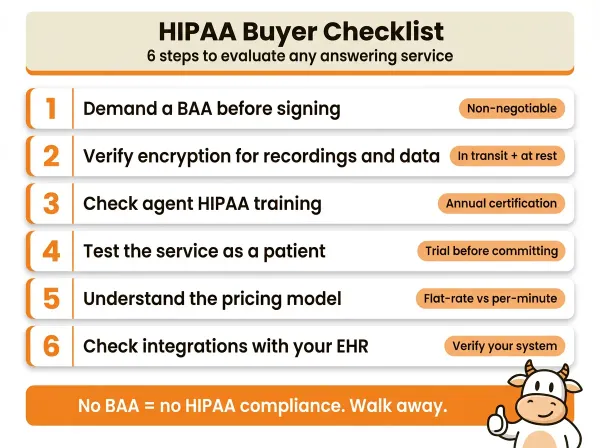
Step 1: Demand a BAA before signing anything
Ask the service for a copy of their standard BAA template. Read it. Make sure it covers the types of PHI your practice handles, specifies breach notification timelines (60 days is the HIPAA requirement), and includes termination clauses. If they hesitate or say "we will send it after you sign up," find another service. A HIPAA-compliant service should have a BAA ready to go.
Step 2: Verify encryption
Ask specific technical questions. "How are recordings or transcripts protected?" "How is data delivered back to us?" "Who can access patient messages?" If the salesperson cannot answer those questions clearly, the person who can should get on the call.
Step 3: Check agent training
Ask how agents are trained on HIPAA. Is it a one-time video or annual certification? Are there competency assessments? What happens when a new agent joins the team? Do they shadow experienced agents before handling live patient calls? Training quality directly correlates with breach risk.
Step 4: Test the service
If the vendor offers a trial or pilot, use it. Call the service as a patient. Ask medical questions. See how agents handle PHI boundaries. Check whether messages arrive securely and accurately. Test after-hours response. Real usage reveals more than any sales presentation.
Step 5: Understand the pricing model
Ask whether pricing is flat-rate or per-minute. Per-minute pricing is transparent but can spike during high-volume months. Flat-rate pricing is predictable but may include unused capacity. Ask about overage charges, setup fees, and whether there are minimum contract terms. Month-to-month is ideal. Annual contracts are common but should include an exit clause.
Step 6: Check integrations
If the service cannot integrate with your EHR or practice management system, you will manually enter every message and appointment. That defeats the purpose. Ask specifically about your system. "Do you integrate with Epic?" is better than "do you integrate with EHRs?"
While you evaluate HIPAA-compliant services, you can start testing CallCow for free on your non-PHI calls in parallel. It takes minutes, not weeks.
AI and HIPAA: the current state
I build AI phone software for a living, so I have opinions about this.
AI phone services are getting good at conversation. CallCow handles appointment booking, FAQ answering, form collection, call transfer, and calendar integrations. CallCow runs on GPT 5.4, which reduces hallucination risk, important when you need accurate information delivery even for non-PHI calls. But HIPAA compliance for AI is a different problem than making a chatbot sound natural.
Here is what changes at each layer. HIPAA requires that PHI be protected at every stage: collection, processing, storage, and transmission. For a human agent, this means training and policies. For an AI system, it means the entire technical stack must be compliant. The LLM processing the call, the infrastructure hosting it, the storage layer for recordings and transcripts, the API layer sending data to your systems. Every component must meet HIPAA's Security Rule.
As of April 2026, AI phone vendors are still early here. Marketing phrases like "enterprise security" or "secure infrastructure" are not the same thing as a HIPAA-ready phone workflow. The real questions are simpler: who touches the PHI, which vendors are in the chain, and are the right agreements and controls in place for that stack?
If a provider claims its AI phone service is HIPAA-ready, ask for the BAA template, ask how PHI moves through the system, and ask which subprocessors are involved. Serious vendors should be able to answer that clearly.
What to do right now
If you need HIPAA-compliant phone answering today, use a human service from the comparison table above. They have years of compliance infrastructure in place.
If you want to reduce costs, use a two-tier setup. Route non-PHI calls (scheduling, hours, insurance questions) to an AI service like CallCow and route PHI calls to a HIPAA-compliant human service.
CallCow is positioned for the non-PHI side of that workflow. It connects through your existing Twilio number (BYOC model), uses structured forms to collect caller data, integrates with Google Calendar and Outlook Calendar in beta plus Calendly, Cal.com, TidyCal, and Trafft for supported scheduling flows, and sends call data via webhooks on completion. Every caller is automatically saved as a contact with their phone number, name, and any collected data, so your front desk starts with context before the patient walks in. If your non-PHI workflow includes sending callers booking confirmations, directions, or resource links, SMS Instructions lets the AI agent text the caller during the conversation. This is useful for office directions, insurance reference links, or scheduling confirmations that are easier to share as a clickable link. It requires Twilio SMS capability. TidyCal paid bookings are excluded through the API, and Trafft books the first available employee rather than a specific one. CallCow always identifies itself as AI. It does not sign a BAA, and we do not claim it can handle PHI.
For PHI calls, you need a service that signs a BAA, encrypts everything, trains agents, and has a breach response plan. That is a human service, at least for now.
CallCow's transfer-to-human feature routes callers to your HIPAA-compliant service or on-call staff when a conversation moves beyond non-PHI territory. Dynamic transfer via webhook lets your system decide the destination based on call content. The caveats matter here too: transfers require a verified Twilio Business Profile and they are cold/blind only.
If your practice handles a mix of administrative and clinical calls, set up a free CallCow trial and test the non-PHI side of your call volume.
Which healthcare businesses need HIPAA-compliant answering?
Not every healthcare-adjacent business needs a HIPAA-compliant answering service. The split depends on whether you handle PHI.
You need HIPAA-compliant answering if:
- Medical practices and clinics that discuss patient conditions, test results, or treatments over the phone
- Hospitals and health systems that route patient calls through a central answering service
- Dental practices that discuss treatment plans and patient history
- Mental health providers that handle sensitive patient information (note: some mental health records have extra protections under 42 CFR Part 2)
- Pharmacies that take prescription refill requests over the phone
- Home health agencies that coordinate patient care via phone
- Telehealth providers that use phone calls as part of patient encounters
- Insurance brokers and health plans that handle member information
You probably do not need HIPAA-compliant answering if:
- Chiropractic, massage, or wellness practices that only schedule appointments and do not discuss medical history or diagnoses
- Medical device companies that handle product inquiries but not patient health data
- Health tech companies that provide software but do not access patient records
- Life coaches and non-licensed wellness consultants who are not covered entities under HIPAA
The distinction is whether you are a "covered entity" under HIPAA (healthcare provider, health plan, or healthcare clearinghouse) and whether you transmit PHI electronically in connection with a covered transaction. If you are unsure, consult a healthcare attorney. The cost of guessing wrong exceeds the cost of a legal opinion.
Hybrid approach by business type
For medical offices that want to keep costs reasonable, the hybrid model can work well. An AI service handles first-line non-PHI calls. Callers who mention symptoms, medications, test results, or other PHI get transferred to a HIPAA-compliant service or your on-call staff.
For after-hours coverage, the calculus shifts. After-hours calls are more likely to involve urgent medical questions, which means more PHI. Practices with significant after-hours call volume should prioritize a HIPAA-compliant service for those hours, even if they use AI during business hours for routing and scheduling.
For voicemail transfer, the same rules apply. If your voicemail system stores messages that patients leave about their medical conditions, that voicemail system is handling PHI and must be compliant. Some practices avoid this by instructing patients not to leave clinical details in voicemail, but that is hard to enforce and easy to forget. For non-PHI voicemails, CallCow's voicemail transfer feature routes missed calls to AI instead of a dead-end greeting, so callers asking about office hours or scheduling get an immediate answer.
For proactive outreach like appointment reminders or recall campaigns, CallCow's list calling feature dials sequentially from a CSV and auto-resumes the next day.
CallCow integrates with Make.com for bidirectional automation, so you can trigger calls from scenarios and receive call data via webhooks. Zapier can trigger calls too, but it is invite-only today.
You can also embed CallCow's calling widget directly on your practice website so patients can trigger a call without dialing.
Who this is for (and who it's not)
Good fit:
- Healthcare practices evaluating their options and trying to understand what HIPAA compliance actually requires before signing a contract
- Practices that want to reduce costs by routing non-PHI calls (scheduling, hours, insurance questions) to an AI service and keeping HIPAA-covered service for PHI calls only
- Anyone comparing NotifyMD, TriageLogic, MAP Communications, and other providers and wanting real pricing data
Not a good fit if you need CallCow for PHI calls. CallCow is not HIPAA compliant. It does not sign a BAA and should not be used for calls involving patient health information. Its role here is limited to the non-PHI portion of your call volume.
Frequently asked questions
What is the cheapest HIPAA-compliant phone service?
There is no single reliable "cheapest" answer because most HIPAA-focused providers use custom quotes. A cheaper operational model can be a hybrid setup: use a non-HIPAA AI service like CallCow for non-PHI calls (scheduling, hours, general questions) and route PHI-related calls to a HIPAA-compliant service. That can reduce the compliant service's workload, but you still need real quotes to know the savings.
How is HIPAA used when dealing with an answering service?
HIPAA applies to answering services through the Business Associate rule. When a healthcare practice shares patient information with a third-party answering service, that service becomes a "business associate" under HIPAA. Both parties must sign a Business Associate Agreement (BAA). The service must encrypt PHI in transit and at rest, train agents on privacy procedures, maintain access controls, and follow breach notification requirements. Without a BAA, the service cannot legally handle any calls involving protected health information.
How much does a medical answering service cost?
HIPAA-focused answering services are usually priced by quote, coverage level, minute usage, and whether you need specialized workflows like nurse triage or EHR integration. The practical move is to compare the vendor's billing model, overages, and contract terms instead of relying on headline ranges from a blog post. A hybrid setup can reduce total cost, but the savings depend on your call mix.
What are the four most common HIPAA violations?
Common HIPAA failures in this context include using a vendor without a signed BAA, mishandling recordings or messages that contain PHI, giving the wrong staff access to patient information, and failing to respond properly when a breach happens. The legal details depend on the incident, but the safe buyer move is to verify the vendor's controls before you hand them patient calls.
CallCow is not HIPAA compliant. We built it for non-PHI calls like scheduling, office hours, insurance questions, and general inquiries. If that split fits your workflow, you can reserve your HIPAA-compliant service for the calls that actually need it. trial at callcow.ai.
Yiming Han is the founder of CallCow and writes about phone automation, missed calls, and the tradeoffs that show up when small businesses actually deploy voice AI.